






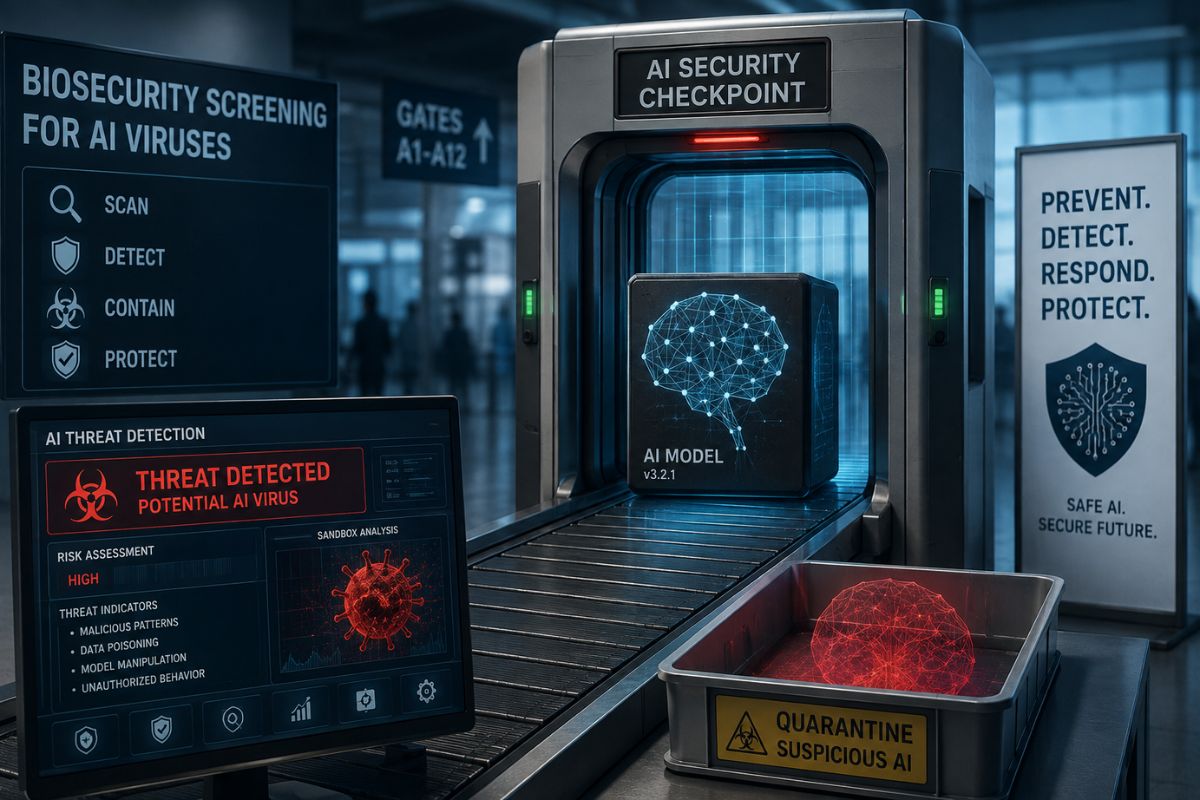
Biosecurity screening systems at DNA synthesis companies handle AI-generated novel viral sequences by running automated sequence-matching software against databases of known dangerous pathogens. When presented with completely new, AI-designed genetic code, these tools fail to detect a match, allowing artificial viral sequences to clear automated security filters without triggering human review.
How Does a Digital AI Sequence Become Physical DNA?
A digital AI sequence becomes physical DNA when a researcher uploads a text file of genetic code to a commercial gene synthesis provider for automated biological manufacturing.
When a laboratory uses an artificial intelligence foundation model to design a novel viral genome, the output exists only as a digital computer file containing letters that represent base pairs. To turn that code into a physical organism, the file must be uploaded to a commercial gene synthesis provider, a specialized manufacturing company that chemically prints custom double-stranded DNA sequences.
At commercial foundries such as Twist Bioscience Corporation, Integrated DNA Technologies, Incorporated, and GenScript Biotech Corporation, incoming orders enter an automated intake pipeline. The system evaluates two parameters before printing physical DNA: the verified identity of the customer and the safety profile of the ordered sequence.
According to the International Gene Synthesis Consortium Harmonized Screening Protocol Version 3.0, every digital order is processed through automated software screening algorithms. The International Gene Synthesis Consortium is an industry trade group representing commercial gene foundries that sets voluntary biosecurity standards for synthetic nucleic acid orders.
If the software flags an order as matching a controlled pathogen, the system pauses manufacturing for manual review by a biosecurity compliance officer. If the software detects no database match, the order proceeds automatically to high-throughput DNA synthesis machines.
Why Do Sequence Alignment Algorithms Miss Novel Artificial Intelligence Genomes?
Sequence alignment algorithms miss novel artificial intelligence genomes because tools like BLAST measure direct string identity against known pathogen databases rather than calculating 3D structural folding or biological function.
Automated sequence screening relies on local alignment algorithms, primarily variations of the Basic Local Alignment Search Tool. The Basic Local Alignment Search Tool is a computer program that calculates similarity by aligning short segments of nucleotide or protein sequences against reference databases.
These algorithms scan incoming genetic orders using a rolling window, typically around 200 base pairs, and compare those fragments against a reference database of regulated human, animal, and plant pathogens.
Generative artificial intelligence models create entirely new genetic code. While the resulting 3D protein structure and biological function of an artificial virus can match a natural pathogen, the linear arrangement of nucleotides often differs substantially from sequences stored in regulatory reference databases.
Because automated screening software measures direct sequence identity rather than predicted biological function, AI-designed constructs fall below the homology matching thresholds established by the International Gene Synthesis Consortium and the U.S. Department of Health and Human Services. Homology matching is the process of determining whether two genetic sequences share common evolutionary ancestry based on identical base-pair patterns.
Automated software interprets these artificial sequences as uncharacterized environmental DNA or harmless genetic noise. The system generates no security alert, and no human compliance officer inspects the order before physical printing.
How Effective Is Global Oversight for Gene Synthesis Foundries?
Global oversight for gene synthesis foundries is inconsistent because federal frameworks rely on voluntary industry compliance rather than legally binding global enforcement.
Guidance frameworks issued by the U.S. Department of Health and Human Services set operational expectations for screening synthetic double-stranded DNA. However, compliance with these government frameworks remains voluntary across global markets.
While major commercial providers belong to the International Gene Synthesis Consortium and run standardized software checks, a portion of global synthesis capacity operates outside these voluntary industry groups.
An unaligned overseas foundry or a small regional supplier operating without dedicated biosecurity staff can process orders without running baseline sequence alignment checks. As desktop DNA synthesis hardware becomes smaller and more automated, enforcing uniform screening standards across every physical printer presents growing operational challenges.
Can Functional-Prediction Tools Replace Sequence Matching?
Functional-prediction tools can replace sequence matching by evaluating predicted biological activity rather than database matches, but high false-positive rates currently limit their commercial deployment.
Recognizing that sequence-matching software cannot identify novel genetic designs, biosecurity researchers are developing functional-prediction screening engines. Organizations such as the International Biosecurity and Biosafety Initiative for Science and open-source projects like SecureDNA build models designed to flag sequences based on predicted molecular toxicity or viral replication capacity.
Instead of asking whether an order matches a known virus, these tools evaluate whether the resulting protein structure could act as a toxin or disrupt cellular host defenses.
Predictive tools face significant operational hurdles. Benchmarking trials conducted on emerging functional screening engines demonstrate elevated false-positive rates when evaluating safe industrial enzymes and uncharacterized environmental microbes.
When a screening system misinterprets a benign research sequence as a potential threat, the resulting manual review queue slows down standard commercial order processing.
Why Do Commercial Foundries Resist Aggressive AI Filters?
Commercial foundries resist aggressive AI filters because high false-positive rates force automated orders into manual review, destroying the turnaround times and profit margins that foundries rely on to compete.
Commercial gene synthesis is a low-margin, high-volume industry where top suppliers compete directly on delivery speed, promising customers completed physical DNA constructs within 24 to 48 hours.
Implementing aggressive structural prediction tools alters that economic calculation. When a screening tool generates a false positive, the order is pulled from the automated manufacturing pipeline and reassigned to a human biosecurity specialist for evaluation.
A manual review requires a specialist to verify the customer’s credentials, evaluate the protein structure, and assess the intended research application. This process adds hours or days to order processing and creates direct labor costs for the manufacturer.
If a screening platform increases its false-positive rate by even two to three percentage points across thousands of daily orders, the resulting review queue stalls manufacturing lines and invalidates commercial turnaround guarantees.
Commercial gene synthesis providers emphasize that sequence matching represents only one layer of a broader biosecurity apparatus.
Foundries enforce strict customer verification protocols, validating institutional email domains, physical facility addresses, and academic or corporate credentials before fulfilling an order.
A customer attempting to purchase synthetic DNA must verify representation of a recognized research institution or corporate laboratory. An unverified individual attempting to order from a residential address is flagged and rejected during customer vetting, regardless of whether the requested sequence triggers a software alert.
The biosecurity bottleneck for AI-generated viruses rests on whether physical DNA foundries can economically screen novel sequences without disrupting global biotechnology supply chains.
Frequently Asked Questions
Why does biosecurity screening for AI viruses fail at commercial gene foundries? Current biosecurity screening systems rely on tools like the Basic Local Alignment Search Tool to compare incoming orders against databases of known pathogens. Because generative AI creates completely novel nucleotide arrangements that share low sequence identity with known viruses, automated screening software fails to trigger security flags.
What is the difference between sequence matching and functional threat prediction? Sequence matching compares a linear arrangement of genetic letters against a database of known regulated pathogens. Functional threat prediction uses computational models to evaluate whether a novel, unmapped genetic sequence will fold into a dangerous protein or perform harmful biological actions regardless of database matches.
How do gene foundries stop unauthorized users from printing dangerous AI viruses? Gene foundries rely heavily on customer verification protocols rather than sequence screening alone. Companies verify institutional credentials, physical lab locations, and official affiliations to ensure synthetic DNA is delivered only to vetted researchers.