






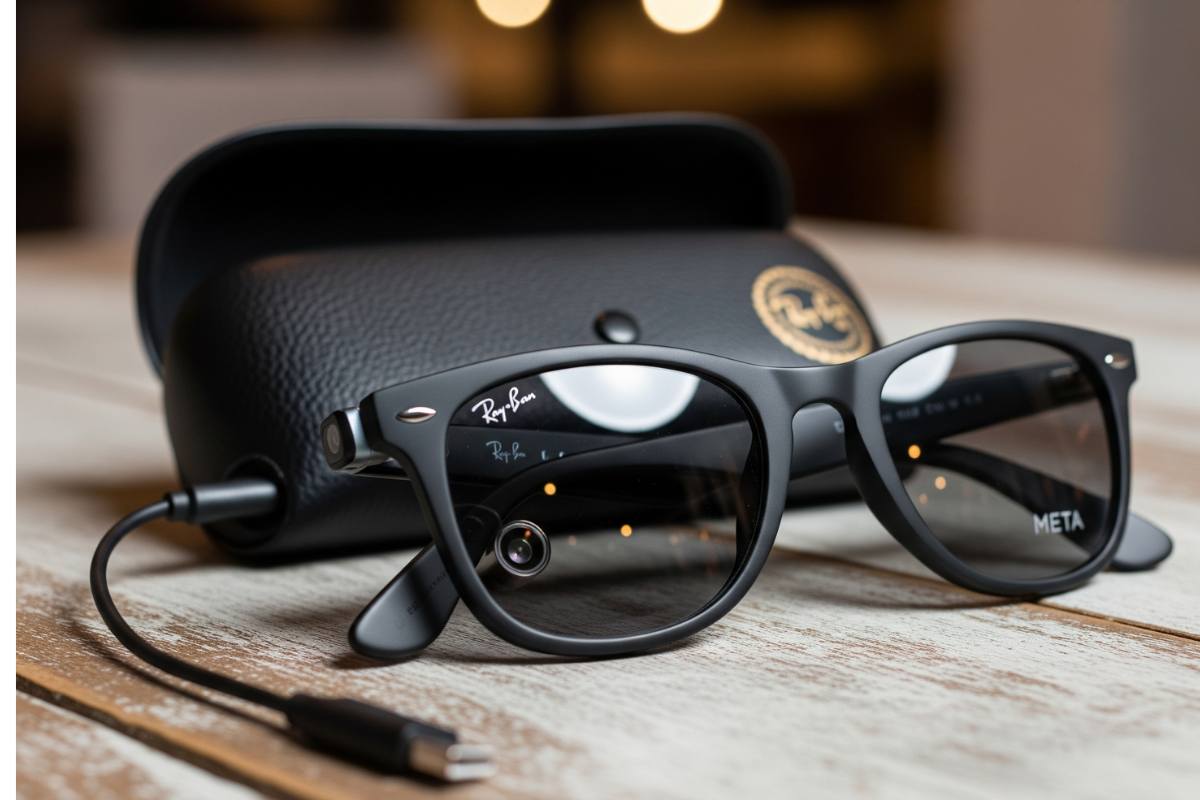
The consumer smart eyewear sector has experienced an abrupt inflection point. Rather than heavyweight augmented reality (AR) visors or optical waveguide headsets, market expansion is being driven by display-less, AI-powered camera and audio frames. Anchored by its industrial partnership with EssilorLuxottica, Meta has captured more than 60% of the global smart glasses market, establishing unit volumes and retail distribution channels that outpace early hardware competitors.
Market Breakout: Shipment Surges and Market Dominance
According to market data from Counterpoint Research, global smart glasses shipments surged 210% year-over-year in 2024, crossing the two-million-unit threshold. Meta accounted for the vast majority of this expansion. Since launching the second-generation Ray-Ban Meta frames in October 2023, cumulative sales have surpassed two million units worldwide, with more than one million pairs sold in 2024 alone.
| Operational Metric | Recorded Data | Industry Source |
|---|---|---|
| Total Cumulative Volume | ~2,000,000+ units (since Oct 2023) | EssilorLuxottica corporate filings / The Verge |
| 2024 Annual Shipments | 1,000,000+ units | Meta internal disclosures |
| Annual Market Expansion | +210% YoY growth across 2024 | Counterpoint Research |
| Meta Global Market Share | 60%+ of AI smart glasses segment | Counterpoint Research Tracker |
| Manufacturing Target | 10,000,000 units/year by end-2026 | EssilorLuxottica earnings statement |
| Revenue Momentum | Ray-Ban Meta revenue tripled (>3x) in H1 2025 | EssilorLuxottica financial results / CNBC |
The Form Factor Compromise: Ambient Audio Over Optical AR
The commercial traction of Ray-Ban Meta reflects a deliberate architectural compromise. Previous attempts at facial computing stumbled over optical physics: integrating microLED waveguide displays created thermal throttling, severe battery penalties, and bulky frames that attracted social stigmatization.
By omitting transparent displays entirely, Meta reduced device weight to conventional eyewear levels while maintaining Ray-Ban’s standard industrial aesthetics (such as the Wayfarer and Headliner silhouettes). Onboard compute focuses on ambient capture: an integrated 12-megapixel camera sensor, open-ear spatial audio drivers, five beamforming microphones, and an on-device neural processing engine paired with smartphone tethering.
Over-the-air firmware updates have steadily evolved the device from a passive media capture peripheral into an ambient assistant. Meta has deployed multi-turn conversational agents, real-time audio translation, multimodal vision querying via Llama-based models, and integrations with accessibility services like Be My Eyes.
Supply Chain Integration as a Moat
Hardware incumbents frequently struggle with retail distribution and prescription lens fulfillment. Meta’s alliance with EssilorLuxottica directly bypasses this bottleneck. EssilorLuxottica controls thousands of optical retail storefronts globally, alongside proprietary prescription manufacturing pipelines that allow smart frames to be fitted with corrective lenses on-site.
With EssilorLuxottica reporting that smart glasses revenue more than tripled year-over-year in the first half of 2025, the eyewear conglomerate has greenlit capital expenditures to scale manufacturing capacity toward 10 million units annually by late 2026. This vertical supply alignment creates economies of scale that will challenge new hardware entrants lacking established optical distribution networks.
Competitive Escalation and Regulatory Constraints
Counterpoint projects a compound annual growth rate (CAGR) exceeding 60% for AI eyewear through 2029, drawing rapid entry from major technology conglomerates. Samsung, Xiaomi, Baidu, and ByteDance are developing competing AI frames targeting various regional price tiers.
As visual intelligence matures across consumer eyewear, audio-visual models examined in our analysis of SoundHound Vision AI will interface with hardware waveguides, while regulatory privacy compliance remains constrained by the European mandates detailed in our report on why Apple stripped cameras from smart glasses.
Meta’s initial market advantage is substantiated by physical scale, deep retail supply lines, and consistent consumer sell-through. As rival ecosystems launch competing hardware in 2025 and 2026, the competitive battleground will pivot from basic hardware feasibility to ecosystem software stickiness, battery longevity, and international regulatory durability.