






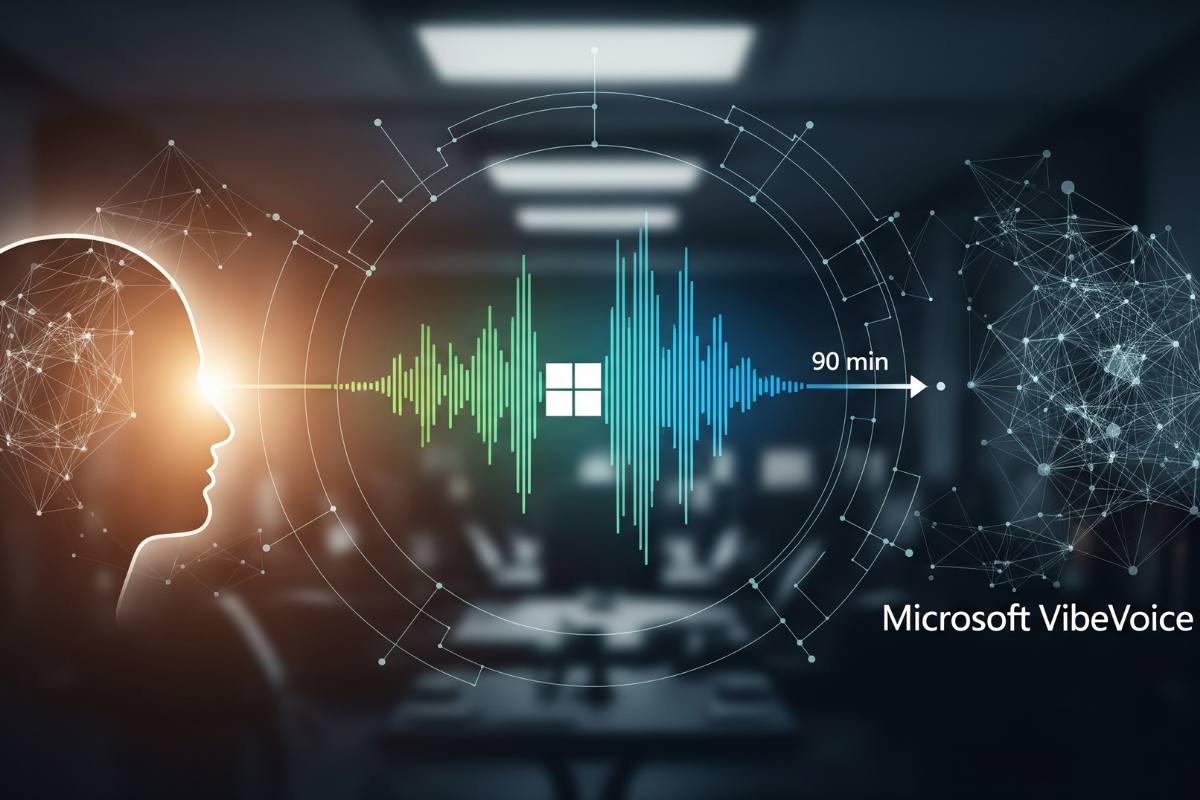
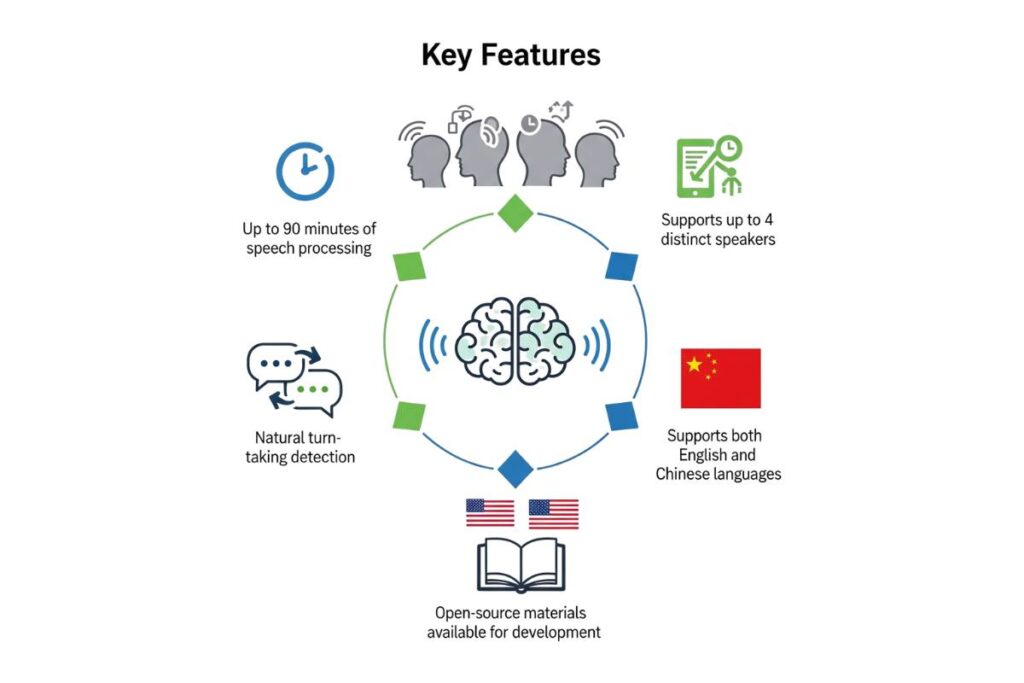
Microsoft has released the source code and model weights for VibeVoice, an open-source text-to-speech (TTS) framework engineered to generate up to 90 minutes of continuous, multi-speaker conversational audio in a single pass. Designed to overcome the acoustic drift and memory bottlenecks common to autoregressive speech systems, the release introduces a hybrid design pairing a language model backbone with a diffusion-based acoustic synthesizer.
Solving Long-Form Audio Drift with 7.5 Hz Tokenization
Generating conversational speech beyond short phrases has historically presented severe scaling challenges. Standard autoregressive speech models struggle past the five-to-ten minute mark, routinely falling into repetitive acoustic loops, unnatural prosodic flattening, or hallucinated speaker identities. These failures stem primarily from high token densities; standard audio codebooks sample at 25 Hz to 50 Hz, causing context windows to exhaust rapidly.
VibeVoice mitigates context bloat by deploying two continuous tokenizers—one acoustic, one semantic—operating at an ultra-low frame rate of 7.5 Hz. This aggressive feature compression enables the underlying model to maintain up to 65,536 tokens in active memory, sufficient to map extended scripts, conversational pacing, and four distinct speaker identities without losing context.
Hybrid Architecture: Decoupling Planning from Acoustics
The system operates by strictly separating conversational structure from low-level audio waveform synthesis. The framework divides computation between two specialized modules:
- Conversational Planning Backbone: Built on a customized Qwen2.5-1.5B core, the language model schedules speaker turns, natural conversational pauses, semantic emphasis, and prosodic transitions across extended dialogues.
- Diffusion Synthesis Head: A lightweight ~123-million-parameter diffusion model synthesizes acoustic Variational Autoencoder (VAE) latents conditioned on the LLM’s planning tokens. Utilizing classifier-free guidance and a fast DPM-Solver, it renders breath marks, vocal micro-textures, and vocal timbre variations.
By delegating “what to say and when” to the LLM and “how it sounds” to the diffusion head, VibeVoice ensures natural speaker handoffs without accidental voice cross-contamination or pitch distortion.
Model Configurations and Hardware Footprint
Microsoft has detailed three primary configurations targeting specific compute envelopes and duration profiles:
| Variant | Context Window | Max Audio Duration | Architecture Profile |
|---|---|---|---|
| 0.5B (Streaming) | Optimized for low latency | Real-time streaming | Lightweight interactive voice assistant deployments |
| 1.5B (Current Release) | 65,536 tokens | ~90 minutes | General long-form generation; requires ~8 GB VRAM |
| 7B (Preview) | 32,768 tokens | ~45 minutes | High-capacity vocal nuance; requires ~18 GB VRAM |
Because the 1.5B model can run within an 8 GB VRAM buffer, developers and independent producers can execute full-episode podcast synthesis and multi-speaker dialogue locally on consumer hardware like the Nvidia RTX 3070 or RTX 4060, bypassing proprietary cloud synthesis fees.
Watermarking, Disclaimers, and Production Scope
To counteract unauthorized voice replication and deepfake misuse, Microsoft embeds both active and passive provenance controls into VibeVoice. Every synthesized track prepends an audible vocal disclaimer designating it as synthetic speech, while an imperceptible acoustic watermark is woven across the audio spectrum for downstream forensic identification.
In its initial release, training is bounded to English and Mandarin, with other languages remaining uncalibrated. Output streams are isolated strictly to dialogue tracks without background music or sound effects, providing audio engineers with clean, non-overlapping vocal stems ready for post-production mixing in digital audio workstations.