





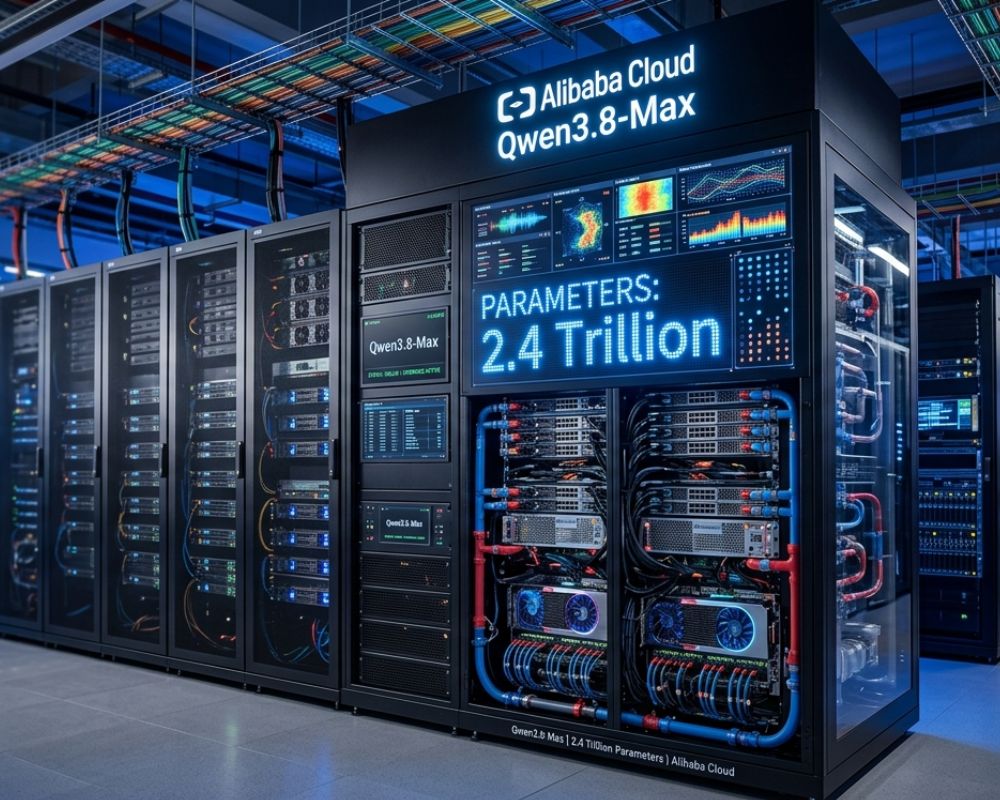
No, your company cannot commercially deploy Alibaba’s Qwen3.8-Max on your own infrastructure without paying licensing fees or switching cloud providers if you cross specific scale thresholds. The Qwen3.8-Max commercial licence requires explicit permission and custom fee structures once an enterprise hits 100 million monthly active users or ¥100 million in annual revenue.
What Are the Restrictions in the Qwen3.8-Max Commercial License?
The standard release documents for Qwen3.8-Max present the model as an accessible download for global developers. The official Qwen License Agreement, however, contains non-negotiable operational limits buried in its commercial usage clauses. Under Section 4 of the agreement, any entity with more than 100 million monthly active users must request an explicit license from Alibaba Group Holding Limited to continue exercising deployment rights.
These conditions diverge sharply from the criteria established by the Open Source Initiative Definition, a global standard that defines whether software grants users total rights to inspect, modify, and redistribute code without fee. Under Section 5 and Section 6 of the OSI framework, a true open-source licence cannot discriminate against specific fields of endeavour or restrict use based on commercial user scale. Alibaba’s terms legally convert Qwen3.8-Max from a freely distributed software asset into a restricted, conditional community release.
Developers who download the model weights, the numerical parameters that define how an artificial intelligence model processes inputs and generates text, assume they hold perpetual, unrestricted rights to execute the software on private compute clusters. In reality, scaling a downstream product past the 100 million user line triggers a mandatory legal requirement to seek express written authorisation and enter separate licensing terms with Alibaba.
How Do Qwen Open Weight Licensing Terms Compare to Apache 2.0 and Llama 3?
Qwen’s open-weight licensing terms create significant commercial obligations compared to standard open-source licences, establishing a user threshold seven times lower than Meta’s 700-million-user cap for Llama 3. A comparative examination of these agreements highlights structural legal commitments for commercial adopters.
| Licensing Feature | Standard Open Source (Apache License 2.0) | Meta Llama 3 Community License | Alibaba Qwen License Agreement |
| Commercial Scale Limit | None. Unlimited commercial use permitted without royalty. | 700 million monthly active users limit before custom licensing. | 100 million monthly active users or ¥100 million revenue threshold. |
| Indemnification Protection | Standard “AS IS” disclaimer; no IP defence provided. | Standard “AS IS” disclaimer; no IP defence provided. | Standard “AS IS” disclaimer; no IP defence provided. |
| Dispute Jurisdiction | Unrestricted; standard legal forum selected by parties. | State or federal courts located in Delaware, USA. | People’s Court of Hangzhou, Zhejiang Province, China. |
| Derivative IP Ownership | Users own derivative modifications fully. | Users retain ownership subject to underlying Meta IP rights. | Users retain derivative ownership subject to the licensor’s foundational IP. |
Unlike the Apache 2.0 framework, which guarantees unencumbered redistribution rights, Alibaba Qwen community licence restrictions establish a commercial ceiling well below competing peer models. Furthermore, any legal disputes or enforcement actions arising under the agreement default to jurisdiction in the People’s Court of Hangzhou, presenting legal compliance teams in Western jurisdictions with distinct foreign arbitration profiles.
How Do Alibaba Qwen Community License Restrictions Force Cloud Migration?
Alibaba Qwen community license restrictions use scale limits to convert high-growth self-hosted deployments into recurring revenue for Alibaba Cloud. The financial architecture behind the model licence guides high-growth enterprise users directly toward Alibaba’s managed cloud services.
When a self-hosted implementation approaches the 100 million user threshold, the operating business faces a structural choice: negotiate an individualised, proprietary commercial licence or transition inference calls to Alibaba Cloud DashScope API pricing infrastructure.
Published commercial rates for hosted Qwen models show input costs set at $0.60 per million tokens and output costs at $3.60 per million tokens for flagship tier variants on Alibaba Cloud DashScope, according to pricing published on BenchLM. For an enterprise processing 50 billion tokens monthly, hosted API bills approximate $100,000 to $150,000 per month, compared to fixed capital expenditure on internal GPU clusters.
By enforcing compliance boundaries at 100 million users, Alibaba ensures that large-scale application developers either generate direct licensing fees or convert into recurring cloud infrastructure clients.
What Are the Jurisdictional and Regulatory Risks of Deploying Qwen?
Western enterprise deployments of Qwen models carry foreign arbitration liabilities because the licence mandates dispute resolution through courts in Hangzhou, China. For corporate legal teams outside Asia, agreeing to the Qwen Community License introduces governance requirements beyond pricing schedules.
Accepting contract terms governed by courts in Zhejiang Province requires cross-border legal risk reviews that many corporate compliance boards flag. Operating mission-critical software subject to foreign jurisdiction clauses creates operational dependencies that contrast with self-contained open software deployments.
These contractual stipulations mean Western enterprises integrating Qwen weights into proprietary software pipelines assume ongoing legal monitoring duties absent in conventional open-source stack components.
Why Are AI Companies Redefining “Open Weights”?
AI vendors use custom “open weight” licences, a distribution model where model parameters are accessible but governed by restrictive usage agreements, to capture developer adoption while locking in hyper-scale commercial monetisation rights. Over recent release cycles, technology providers have redefined software distribution terminology for foundation models.
While early artificial intelligence models were distributed under permissive open licenses, modern trillion-parameter architectures are increasingly released under custom commercial agreements. Phrases like “open weight” have largely supplanted strict open-source designations in corporate announcements, allowing firms to build developer mindshare while maintaining legal mechanisms to monetise hyper-scale enterprise deployments.
Alibaba Cloud did not respond to requests for comment regarding its enterprise licensing approval process prior to publication.
Alibaba has previously noted in public developer documentation that scale restrictions prevent rival cloud service providers from commercialising model weights without contributing to foundational development expenses while keeping access royalty-free for researchers, academic institutions, and early-stage startups.
The central evaluation for corporate engineering leads remains clear: downloading parameters today creates a direct legal relationship that dictates how a product can scale tomorrow.
Frequently Asked Questions
Is Alibaba’s Qwen3.8-Max open source according to OSI standards?
No. The Open Source Initiative requires licences to permit unrestricted commercial use and field-of-endeavour adoption without user-scale ceilings. Because the Qwen license imposes custom licensing demands at 100 million monthly active users or ¥100 million in revenue, it does not meet official open-source criteria.
What happens if a company uses Qwen3.8-Max and exceeds 100 million users?
Crossing the 100 million monthly active user threshold revokes the royalty-free usage grant provided in the community licence. The operating enterprise must contact Alibaba Group to negotiate a custom commercial license or migrate its model workloads to Alibaba Cloud’s DashScope platform.
How does Qwen3.8-Max’s commercial threshold compare to Meta’s Llama 3?
Qwen3.8-Max sets its scale restriction at 100 million monthly active users or ¥100 million in revenue, whereas Meta’s Llama 3 community licence allows up to 700 million monthly active users before requiring an enterprise agreement. This makes Qwen’s commercial ceiling seven times lower than Meta’s.