






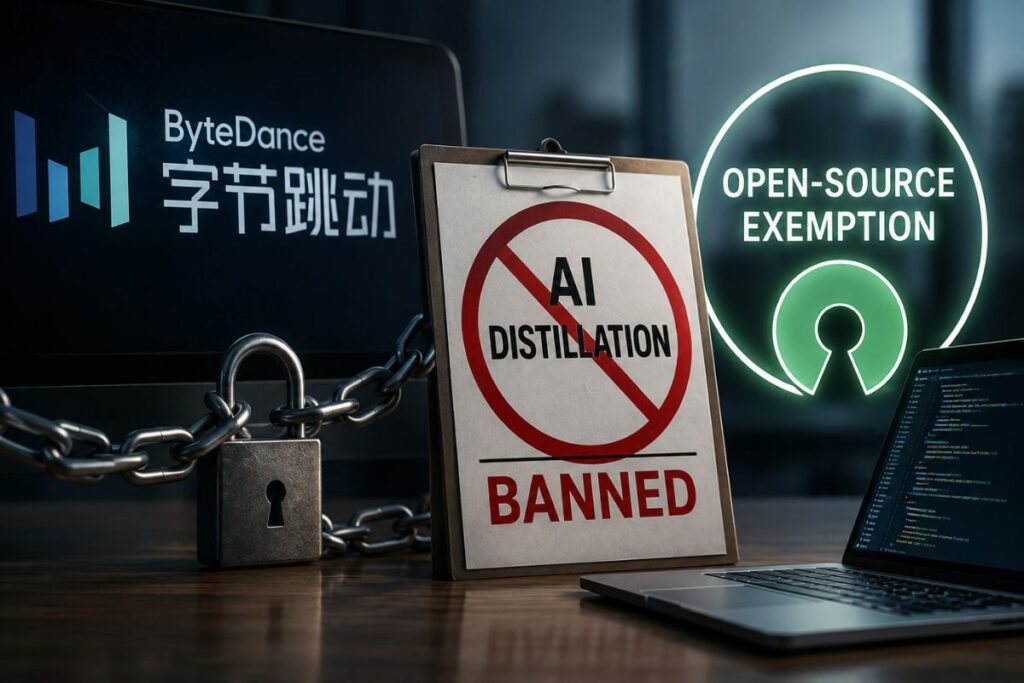
ByteDance founder Zhang Yiming recently directed developers to halt model distillation—the practice of training smaller AI models using outputs from advanced systems. However, internal documents indicate the mandate is narrower than initially reported. Instead of a complete ban on synthetic data, the policy strictly restricts closed commercial APIs while explicitly exempting open-weights models.
The new guidelines prohibit data extraction from proprietary systems operated by OpenAI, Anthropic, and Google. ByteDance researchers can still legally distill synthetic training data from permissively licensed open-weights models. This includes Meta’s Llama series and advanced reasoning architectures like DeepSeek-R1.
Data Governance Guidelines at ByteDance
Directives sent to ByteDance’s Seed foundational AI group and the Doubao engineering team categorize data sources into two legal classifications:
- Prohibited (Class A): Closed commercial endpoints that require developer accounts, including OpenAI’s GPT-4o, Anthropic’s Claude 3.5 Sonnet, and Google’s Gemini models.
- Permitted (Class B): Open-weights foundation models featuring publicly downloadable code and parameter weights, such as Meta’s Llama 3 series and DeepSeek-R1.
To enforce compliance, the ByteDance infrastructure team introduced automated data-ingestion pipeline filters. These internal tools scan metadata on incoming synthetic datasets. If a batch contains payload signatures from commercial API endpoints, the system rejects it automatically. Conversely, synthetic reasoning traces generated on self-hosted instances of open-weights models pass through the filters seamlessly.
Prioritizing Legal Risk Management
ByteDance’s updated policy stems directly from legal risk mitigation. Section 2(c) of OpenAI’s Terms of Use explicitly prohibits using its model outputs to develop competing AI systems. In late 2023, OpenAI suspended ByteDance’s developer accounts after finding engineering teams used GPT-4 outputs via Microsoft Azure APIs to train Project Seed.
This suspension forced heightened compliance standards. Unlike specialized Chinese AI labs like Moonshot or Minimax, ByteDance operates massive global assets and faces intense regulatory scrutiny in Washington regarding TikTok. A breach-of-contract lawsuit from OpenAI or Anthropic would trigger severe commercial repercussions in Western jurisdictions.
Open-weights licenses offer distinct legal protections. The Meta Llama 3 Community License Agreement permits standard commercial use and modification. By shifting its synthetic pipeline to open-weights models, ByteDance effectively shields its AI portfolio from Western intellectual property disputes.
How This Impacts Doubao Training Pipelines
The open-weights exemption enables ByteDance to sustain research momentum for its Doubao models without incurring the massive computational expense of training from scratch.
Zhang acknowledged that abandoning proprietary distillation could temporarily cause ByteDance models to lag behind domestic rivals in benchmark scores. However, engineering workflows show teams offsetting this gap by extracting synthetic data from open-source models like DeepSeek. Internal compute-scheduling logs indicate researchers run local inference clusters of open-weights reasoning models to produce self-correction logs and chain-of-thought training data. This supplies the Doubao training pipeline with high-quality synthetic data while bypassing closed Western APIs entirely.
This strategy also secures Volcano Engine, ByteDance’s enterprise cloud division. Multinational software buyers now demand strict, audit-proof guarantees regarding the intellectual property lineage of commercial AI models. By ensuring Doubao’s foundation models maintain a verified, clean lineage, Volcano Engine can confidently provide robust IP indemnification clauses to its global enterprise clients.