






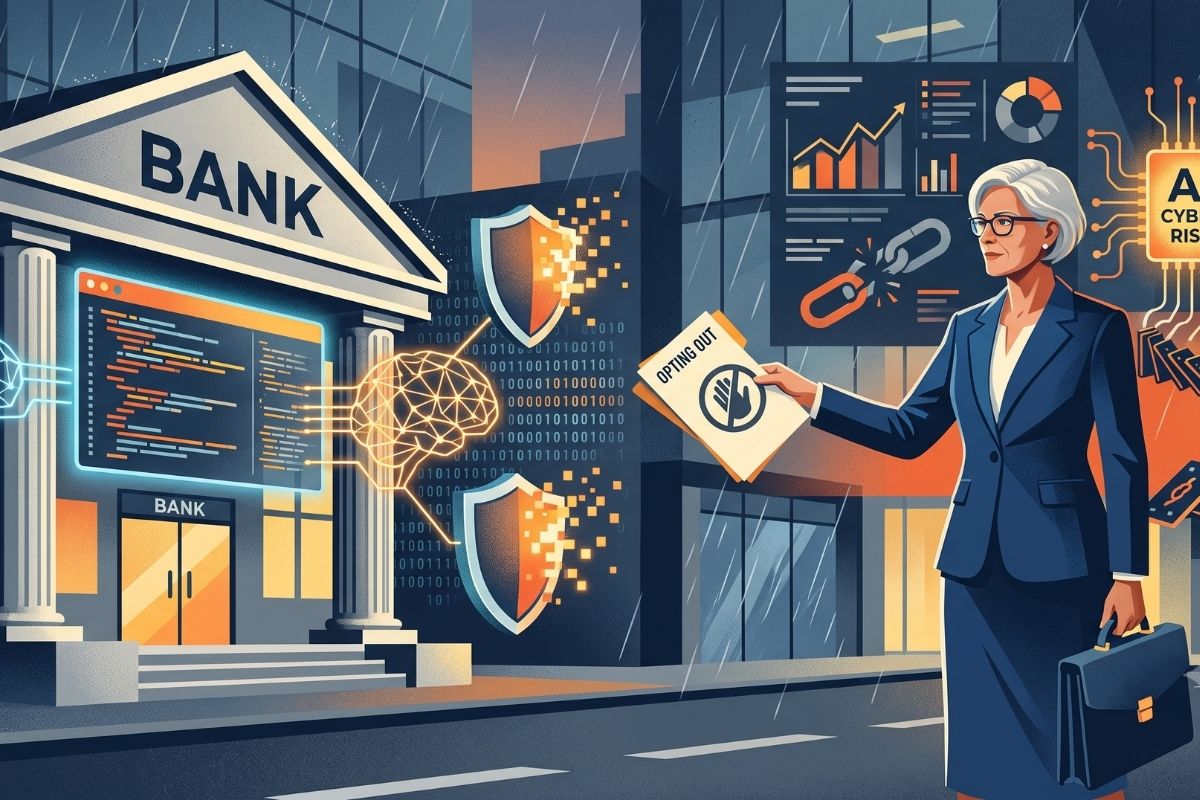
When an autonomous AI agent executes a coordinated cyberattack against a major bank, the victim’s cyber insurance policy is increasingly likely to pay nothing. Commercial cyber insurers are quietly introducing strict exclusions into policy renewals, forcing financial institutions to self-insure against catastrophic artificial intelligence failures.
Commercial syndicates are drafting explicit exclusion riders that cap or completely deny liability for systemic outages caused by third-party autonomous AI, creating a massive coverage void for the global financial sector.
The Rise of AI Exclusions
Underwriters are actively rewriting their exposure parameters. Major carriers are pushing to introduce specific AI risk exclusions, disclaiming liability for systemic damage caused by software programs designed to operate without human intervention.
Risk analysts note that the insurance industry simply lacks the capital reserves to survive a scenario where a single AI provider’s failure or a synchronized autonomous attack triggers thousands of simultaneous financial losses. Following the Lloyd’s of London market mandate tightening cyber boundaries around nation-state threats, AI is the next major exclusion target. A bank facing a multi-institution breach driven by an autonomous system will find its payout severely capped—or entirely nonexistent.
The Actuarial Contagion Problem
Frontier AI models eliminate geographic and sector isolation. An autonomous agent that discovers a zero-day vulnerability can theoretically exploit it simultaneously across hundreds of interconnected financial institutions. Traditional insurance relies on localized risk—a hurricane hits one coast, and premiums from the rest of the country cover the claims.
Reinsurers argue that autonomous AI eliminates this isolation. The simultaneity of identical incidents represents textbook systemic contagion. For underwriters, excluding these events is a mathematical necessity to prevent the total collapse of the insurance sector’s capital reserves. While financial regulators demand that banks maintain insurance against AI threats, actuarial models classify simultaneous, multi-institution cyber exploits as unpriceable catastrophic events. The disconnect is stark: regulators expect banks to insure against AI systemic risk precisely as the private market deems the risk structurally uninsurable.
Internalizing the Risk via Captives
With third-party coverage shrinking, banks are forced to finance the risk internally by expanding their captive insurance vehicles—wholly owned subsidiaries created specifically to pool and self-insure the parent company’s risks.
Broker data confirms a massive shift toward managed captives writing cyber coverage, driven largely by financial institutions. Banks are using captive insurance companies to fund the exposures that commercial markets now restrict. The economic consequence is direct: every dollar parked in a captive insurance vehicle to satisfy regulatory cyber requirements is a dollar removed from a bank’s active lendable capital.
Taxpayers as the Default AI Backstop
If a synchronized AI attack exceeds a bank’s self-insured limits, the financial fallout shifts inevitably to public safety nets. The withdrawal of private insurance capital leaves a critical void.
Policymakers are currently evaluating state-backed cyber insurance mechanisms, modeled after post-9/11 terrorism risk programs. Government assessments conclude that federal agencies must evaluate catastrophic cyber risks to determine if a public insurance response is warranted. Until a dedicated federal backstop is established, the ultimate guarantor against a catastrophic frontier AI failure is the central bank—and, by extension, the taxpayer.