






Parents face a persistent dilemma: navigating the tightrope between managing screen time and providing developmental advantages. Educational games and language apps often lock children behind a glass screen, creating a passive learning environment.
San Francisco-based startup Polyglot AI is tackling this problem with hardware, not software. The company has introduced Dex, a portable, AI-powered camera designed to reshape how young children learn languages by interacting with the physical world.
What is the Dex Camera?
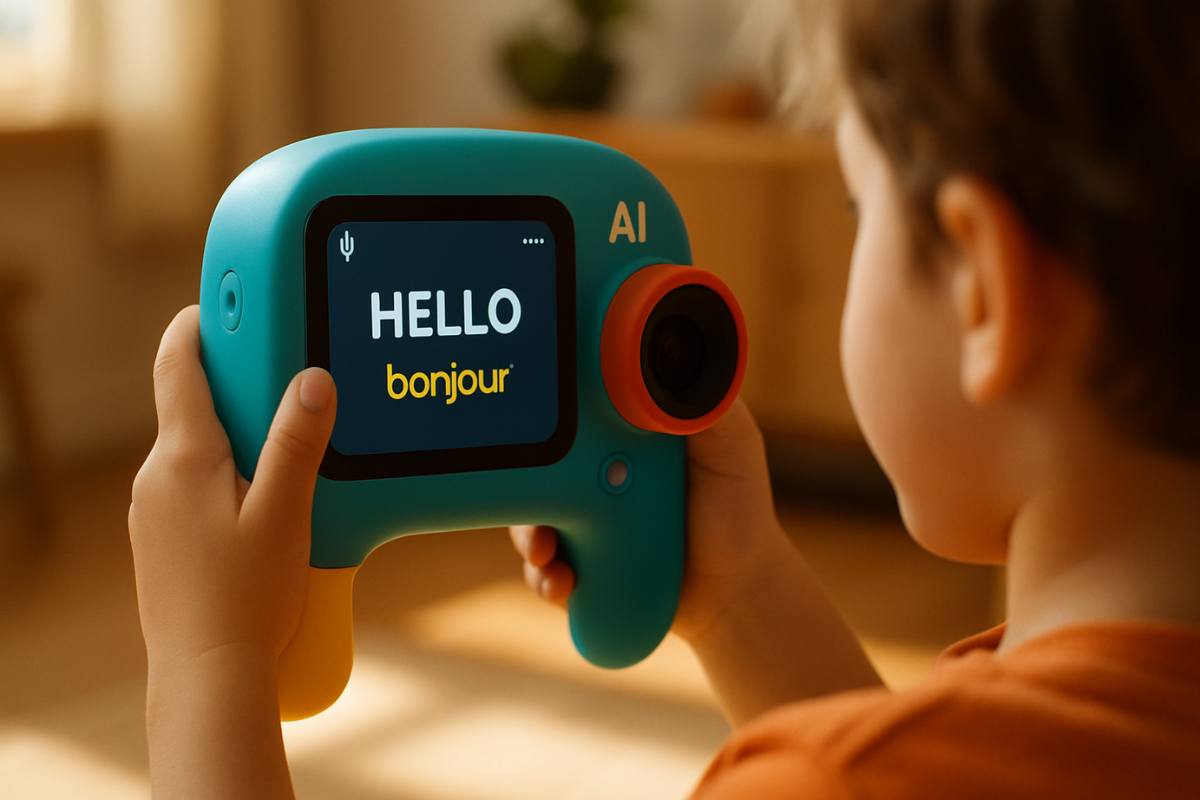
On the surface, Dex resembles a durable, brightly-colored toy camera built for preschoolers. It features an ergonomic grip, a single clickable button, and a rugged exterior designed to withstand drops. However, beneath the chassis lies an advanced educational tool.
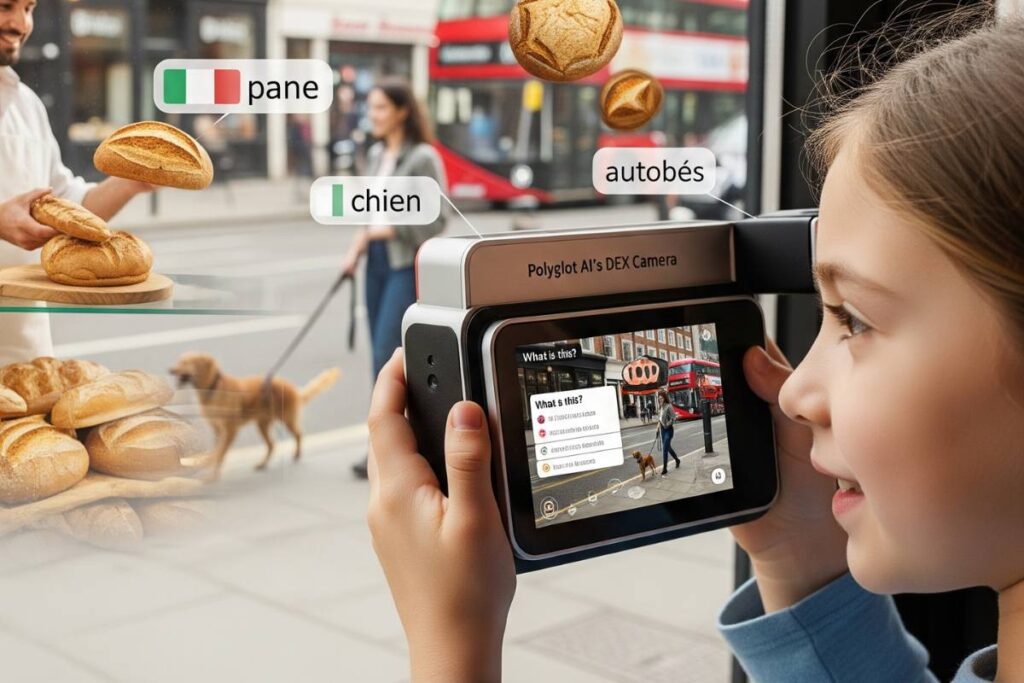
When a child points Dex at a household object—such as a chair, a teddy bear, or an apple—and presses the button, the device’s internal AI identifies the item. A built-in speaker then announces the object’s name in a selected second language. For instance, pointing at an apple will prompt a clear voice to say, “Manzana.” Simultaneously, the word appears on a small, low-glare E-ink screen on the back, reinforcing vocabulary for early readers.
The Technology Powering Point-and-Learn AI
Dex relies on a sophisticated blend of cutting-edge artificial intelligence to deliver real-time, context-based learning.
- Advanced Computer Vision: A powerful on-device computer vision model processes the camera feed in real time. Trained on a massive dataset of household items, the AI identifies physical objects with high accuracy.
- Natural Language Processing (NLP): After identifying an object, the system accesses its multilingual lexicon. It uses correct articles and pronunciation through high-quality text-to-speech synthesis rather than a basic dictionary lookup.
- Generative AI Core: The underlying system is generative, allowing it to learn and adapt. Polyglot AI plans to use this architecture for future updates, introducing descriptive phrases and interactive scavenger hunts based on the child’s environment.
Founding Polyglot AI: A Solution to Passive Screen Time
Polyglot AI was co-founded by Dr. Elena Vance, a computational linguist, and Mark Chen, a former senior AI engineer at a major tech firm. Both parents were frustrated by the limitations of existing language-learning apps.
“The apps were either glorified video players or tap-and-repeat games that held my kids’ attention for five minutes,” Dr. Vance explained. “The Spanish word for ‘milk’ was just a cartoon on a screen, completely disconnected from the carton of milk in our own fridge.”
By merging Vance’s linguistics expertise with Chen’s experience in shrinking neural networks for handheld devices, Polyglot AI created a tool that demands physical engagement. Child development experts emphasize that active engagement—where a child physically interacts with their environment—is vastly superior to passive consumption, which is linked to shortened attention spans and language delays.
Privacy-First Architecture: Keeping AI Safe for Kids
Placing an AI-powered camera in a child’s hands immediately raises privacy concerns. Polyglot AI addressed these risks by implementing a strict, privacy-first hardware architecture.
- On-Device Processing: Image recognition and language lookups happen entirely on the device. Photos taken by the child are not uploaded to cloud servers.
- Anonymized Metadata: The only data transmitted is anonymized feedback to improve AI models (e.g., correcting mislabeled objects). No personal information or images are attached.
- No Microphone: Despite having a speaker, Dex does not feature a microphone. The interaction is strictly one-way, ensuring family conversations are never recorded.
- Parental Controls: A companion app for parents allows them to manage settings, set off-limits times, and review vocabulary progress.
Pricing, Availability, and Future Features
Backed by a recent $15 million Series A funding round led by EdTech venture capital firms, Polyglot AI is preparing to ship Dex this November. The device is currently available for pre-order at $199.
At launch, Dex will support five languages: Spanish, French, Mandarin Chinese, German, and English. The company plans to roll out additional languages via over-the-air software updates in 2026.
Future updates aim to leverage the generative AI core for advanced features, including interactive scavenger hunts (e.g., “Find something rojo“), simple sentence building (“El gato está durmiendo“), and AI-generated storytelling based on the objects a child scans.
Polyglot AI’s vision extends beyond language. The company views Dex as a foundational platform for hands-on, AI-powered education, with potential future applications in subjects like science and biology.