






India AI data center subsidies reward commercial developers with land and tax concessions covering up to a quarter of facility construction costs. Over four-fifths of that subsidized server floor space houses standard database storage and corporate web hosting, not the high-density silicon required for AI.
How Much Do State Data Center Policy Concessions Lower Developer Capex?
State data center policy concessions reduce baseline structural capital expenditure for private developers by 18% to 26% across India’s primary digital infrastructure corridors. These fiscal concessions refer to statutory tax rebates, subsidized land plots, and utility waivers granted by regional authorities to attract high-investment digital infrastructure.
State governments across India compete for facility investments by offering multi-tiered incentive frameworks under the Maharashtra IT & ITeS Policy, the Uttar Pradesh Data Center Policy, and the Tamil Nadu Data Centre Policy:
- Land acquisition: Concessional plot allotments through agencies including the Maharashtra Industrial Development Corporation (MIDC) and the Yamuna Expressway Industrial Development Authority (YEIDA), priced at discounts against standard commercial circle rates.
- Transaction duties: Full 100% waivers on stamp duty and registration fees for initial land purchases and long-term lease transfers.
- Power and operational expenses: Ten- to twenty-year exemptions from state electricity duties, coupled with waivers on cross-subsidy surcharges and wheeling charges for green energy transmission.
A consolidated financial mapping across the primary data center clusters, Navi Mumbai in Maharashtra and Greater Noida in Uttar Pradesh, shows the cumulative scale of these provisions. When combining stamp duty waivers, statutory land discounts, and permanent electricity duty holidays, the state transfers fiscal value equal to 18% to 26% of a developer’s core civil construction bill.
What Is the Difference Between Co-Location Server Farm Capacity and True AI Densities?
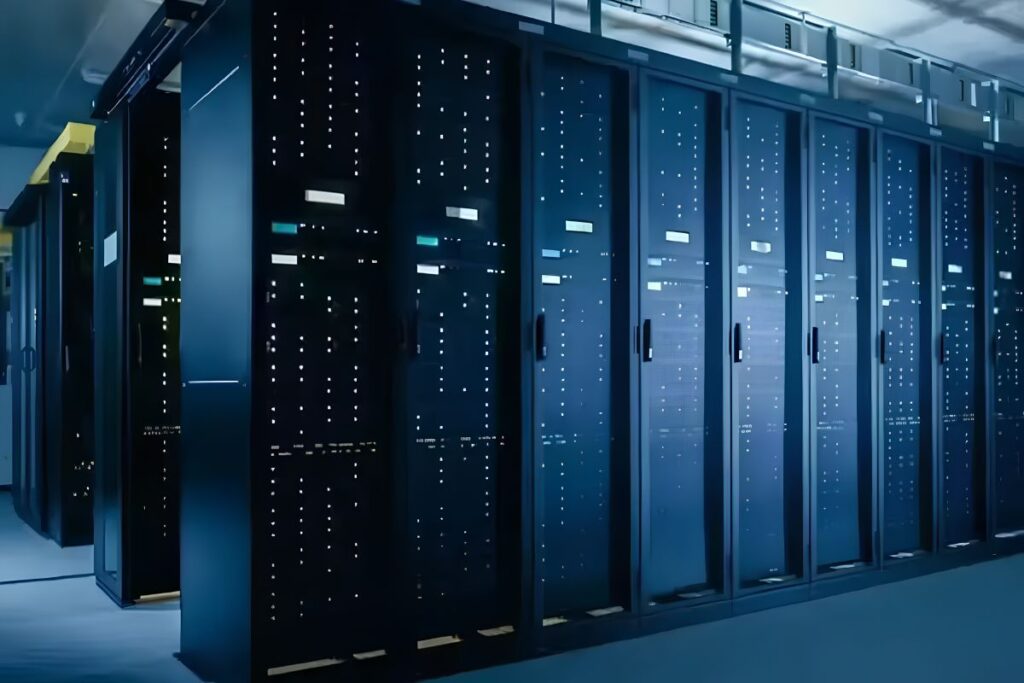
The difference lies in electrical power and thermal engineering: traditional co-location facilities supply 4 to 10 kilowatts per rack using chilled air, whereas AI training clusters demand 30 to 100 kilowatts per rack requiring direct-to-chip liquid cooling. A co-location server farm refers to a commercial data center where third-party businesses rent floor space, electrical power, and cooling for their proprietary servers.
Running modern artificial intelligence workloads, specifically model training and parameter fine-tuning on clusters such as Nvidia Corporation H100 or B200 tensor-core graphics processing units, requires between 30 and 100 kilowatts (kW) of continuous power per rack cabinet.
According to environmental clearance filings submitted to the Ministry of Environment, Forest and Climate Change PARIVESH Portal, mechanical schematics, and utility load sanction requests, over 80% of operational and approved data center capacity in India is engineered at legacy 4- to 10-kW thresholds.
Housing dense processor racks in these buildings is not a simple software update. Increasing rack density requires rebuilding electrical power buses, reinforcing floor-slab weight tolerances, and installing closed-loop liquid-coolant pipes, structural retrofits that require taking operational server rooms offline.
Did Earlier IT Special Economic Zones Create the Template for Data Center Subsidies?
The current server expansion directly mirrors the speculative special economic zone (SEZ) boom between 2005 and 2010, when commercial developers used export park designations to secure agricultural land conversions and tax exemptions. A Special Economic Zone is an officially designated industrial territory governed by duty-free trade rules and tax holidays to encourage commercial exports.
According to the Comptroller and Auditor General of India Performance Audit on SEZs (Report No. 21 of 2014), operations commenced on only 62% of the 45,635 hectares of land notified nationwide for SEZ development, leaving thousands of acres unused for years. The federal audit documented that developers raised ₹6,309.53 crore in commercial bank mortgages on those subsidized land parcels, while actual employment fell short of targets by 65% to 96% across audited locations.
After securing zoning conversions, access roads, and corporate tax breaks, large portions of those footprints sat empty or turned into conventional office leases rather than driving new software development. Contemporary state data center policies employ an identical financial mechanism, trading software office campuses for power substations.
How Do Special Purpose Vehicles Fund Data Centers Without AI Tenant Contracts?
Developers fund data center developments through asset-backed real estate loans secured against 10- to 15-year commercial enterprise leases rather than high-risk AI computing contracts. A Special Purpose Vehicle (SPV) is a legally separate corporate subsidiary formed to isolate project assets and debt from the parent company’s balance sheet.
Filings with the Ministry of Corporate Affairs (MCA-21) Portal show that domestic infrastructure conglomerates establish joint ventures with global facility operators to finance these sites.
Credit rating evaluations published across the CRISIL Credit Ratings Research Hub, ICRA Ratings Disclosures, and CareEdge Ratings demonstrate that lenders underwrite project debt against long-term contracts signed with retail banks, multinational cloud services, and telecom operators requiring standard data backups.
Enterprise leases generate the operational cash flow to repay bank debt. State industrial subsidies, including land rebates and electricity duty holidays, increase the developer’s equity yield. The technology risk of whether local companies ever purchase domestic AI compute remains fully decoupled from the building’s loan structure.
How Do Data Center Electricity Duty Exemptions Strain State Power Distribution Utilities?
Data center electricity duty exemptions drain industrial revenue streams from cash-strapped state power distribution companies (DISCOMs), which must absorb round-the-clock baseload demand without earning standard utility surcharges. A distribution company (DISCOM) is a state-regulated public utility responsible for purchasing electrical power from generators and distributing it to retail consumers.
A single 100-megawatt (MW) server campus draws steady electricity on the scale of an entire industrial town. Regulatory filings before the Maharashtra Electricity Regulatory Commission (MERC) and the Tamil Nadu Electricity Regulatory Commission (TNERC) confirm that state distribution companies lose high-margin duty receipts because state policies grant open-access wheeling charge exemptions to server developers.
According to the Power Finance Corporation (PFC) Annual Performance Reports of State Power Utilities, state utilities, including Maharashtra State Electricity Distribution Company Limited (MSEDCL) and Tamil Nadu Generation and Distribution Corporation (TANGEDCO), carry tens of thousands of crores in accumulated operational losses, which are worsened when high-volume industrial consumers are excused from paying cross-subsidy fees.
Cooling demands add parallel pressure to municipal water supplies. Large evaporative cooling towers at major server hubs consume millions of liters of treated municipal water daily in districts where factories and residential neighborhoods already compete for supply quotas.
Why Do State Governments Fail to Audit Server Rack Power Density for AI?
State governments fail to audit server rack power density for AI because policy compliance measures only building construction milestones and capital spending, entirely omitting hardware verification. State industrial bureaus grant full financial packages once an operator proves it spent capital on civil engineering and secured an electrical grid connection.
State monitoring panels perform no inspections of installed processor architectures, server rack power density, or thermal equipment. A data hall filled with standard mechanical storage drives earns the exact same state tax incentives as a high-performance cluster running advanced neural networks.
Infrastructure executives and regional investment officers maintain that physical foundations must precede hardware purchases. Building high-voltage electrical substations, concrete shells, and redundant fiber conduits takes two to three years, whereas advanced computing chips can be installed within weeks once customer demand emerges. Under this industrial approach, subsidizing basic real estate and grid hookups limits private developer risk, preparing the physical site for advanced workloads when corporate demand arrives.
Until state administrators tie public subsidies to verified hardware densities rather than vacant floor space, public revenue will continue backing standard commercial real estate packaged as frontier computing.
Frequently Asked Questions
What are the primary incentives provided under India AI data center subsidies?
State industrial policies across Maharashtra, Uttar Pradesh, and Tamil Nadu offer full 100% stamp duty exemptions, concessional land acquisition through state development corporations, and 10 to 20 years of electricity duty waivers. Across the major hubs of Navi Mumbai and Greater Noida, these fiscal packages equal 18% to 26% of a developer’s baseline structural construction capex.
Can regular co-location data centers run high-performance AI workloads?
No, not without major structural overhauls. Standard co-location facilities provide 4 to 10 kilowatts per rack using conventional air conditioning, whereas frontier AI training chips demand 30 to 100 kilowatts per rack and require direct liquid cooling to avoid thermal failure.
Why don’t Indian state policies require data center operators to run actual AI chips?
Current state data center policies tie tax exemptions and land rebates entirely to civil investment milestones, building completion dates, and sanctioned electricity loads. State industrial monitoring committees do not audit processor types, rack densities, or computing workloads after the building opens.