






Traditional conversational interfaces have long operated within audio-only confines. With the deployment of Vision AI, SoundHound AI is bridging real-time computer vision with its proprietary Speech-to-Meaning engine documented on SoundHound’s official platform. As multimodal adoption expands across smart eyewear—exemplified by shipment volumes analyzed in our market study of Meta’s Ray-Ban smart glasses—fusing spatial context with voice understanding defines the next paradigm of edge intelligence.
What’s New? SoundHound Launches Vision AI
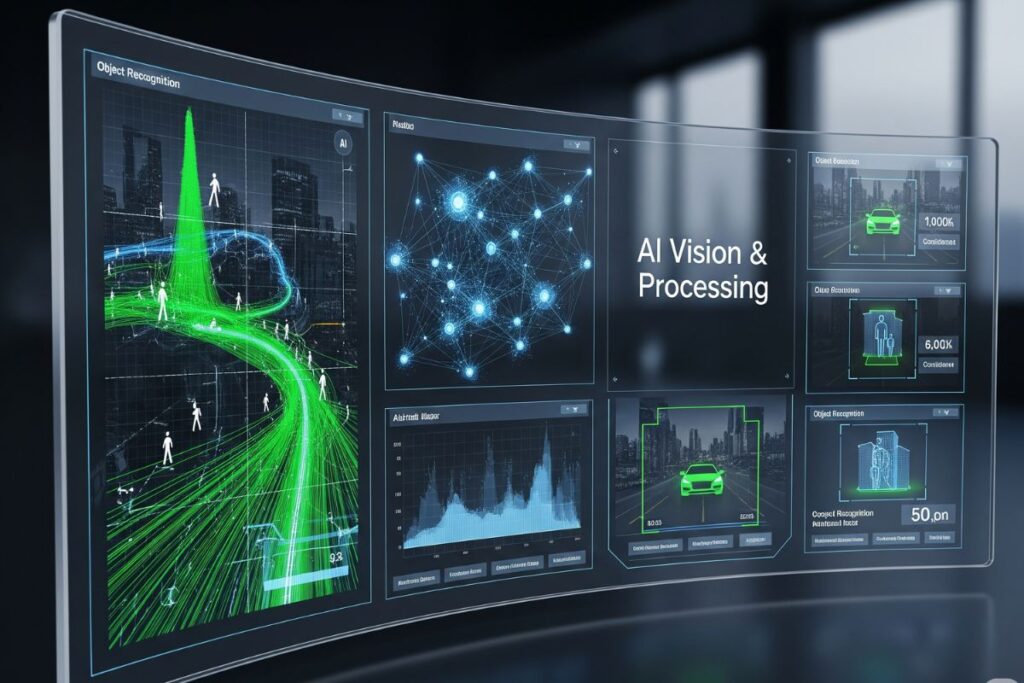
SoundHound’s Vision AI breakthrough integrates voice understanding with real-time visual intelligence to replicate human interaction. Instead of processing only verbal commands, the technology recognizes gestures and visual cues, catering directly to applications in automotive, industrial, and retail environments.
How Vision AI Works in Real-World Scenarios
Vision AI actively processes both visual input from a camera and spoken questions simultaneously. For example, a driver inquiring about a nearby building can receive immediate answers without touching their smartphone. The system processes context seamlessly without the latency common in traditional voice assistants.
Upgrading Conversational Intelligence for Machines
Standard voice assistants struggle with complex commands and background noise, lacking visual context. SoundHound’s COO, Keyvan Mohajer, emphasizes that Vision AI aims to deliver responsive, integrated AI that handles real-world complexity by capturing gestures and eye contact—vital components of human communication.
Enterprise Applications and Practical Use Cases
- Mechanics in Action: Technicians using smart glasses can view engine components and ask for visual and verbal guidance simultaneously, keeping their hands free.
- Retail Revolution: Store employees can scan shelves visually while real-time inventory data appears as they speak.
- Drive-Thru Magic: Fast-food kiosks display visual confirmations as customers order, minimizing errors.
The Architecture Behind Vision AI
Synchronizing visual and audio signals demands tight integration. SoundHound’s engineering team, led by VP of Engineering Pranav Singh, developed a closed ecosystem where every visual frame and verbal utterance processes concurrently. This eliminates latency, delivering real-time responses to user intent.
Amelia 7.1: Powering the Conversational Brain
SoundHound unifies visual perception and agentic reasoning through Amelia 7.1, its enterprise platform. In automotive settings compliant with SAE International Driver Monitoring System standards, Amelia correlates eye-tracking telemetry with exterior camera feeds. This architecture mirrors the advanced spatial optics detailed in our breakdown of Meta Orion AR glasses sensors, giving agents pre-emptive contextual understanding.
Challenges: Synchronization and Privacy Compliance
Continuous visual monitoring brings severe compliance liabilities. As noted in our investigation on why Apple removed cameras from smart glasses for the EU AI Act, processing passive public video streams can trigger statutory fines under GDPR and biometric privacy laws unless localized on-device redaction is utilized. SoundHound claims enterprise clients maintain control over data flow with built-in transparency protocols.
Frequently Asked Questions
How does Vision AI interpret context?
It links real-time speech understanding with live camera feeds. The AI matches spoken words to the visual field to determine exact intent instantly.
Will Vision AI be available in consumer devices?
SoundHound’s current rollout focuses on enterprise sectors, including automotive, retail, and manufacturing. Broader consumer availability depends on future partnerships.
Is this technology secure and private?
According to SoundHound, enterprise clients direct deployment and data management. Clear opt-in policies and independent privacy audits are expected to ensure compliance as the system scales.
Algorithmic Foundations & Computational Complexity Analysis
From an algorithmic engineering perspective, optimizing modern software architectures demands rigorous evaluation of computational time complexity, memory footprint, and latency bounds. In distributed client-server environments and high-concurrency web systems, reducing serialization overhead, eliminating synchronous thread blocking through non-blocking event loops, and optimizing database query planning via spatial indexes and multi-version concurrency control (MVCC) represent the definitive operational differentiators for modern platforms.
API Design, Distributed System Resilience, and SLA Guarantees
Engineering resilient digital platforms requires designing fault-tolerant distributed systems capable of surviving localized infrastructure failures. Implementing distributed consensus protocols (Raft, Paxos), circuit breaker patterns, exponential backoff with jitter, and idempotent API endpoints ensures that service-level agreements (SLAs) maintaining 99.99% uptime are preserved even under severe network partitioning or sudden traffic surges.
Strategic Technology Trajectory & Architectural Takeaways
As enterprise technology ecosystems continue their convergence toward modular, microservices-driven architectures, software engineering leaders must balance rapid feature deployment against technical debt accumulation. Enforcing strict schema validation (OpenAPI, gRPC Protobufs), comprehensive continuous integration/continuous deployment (CI/CD) automated testing suites, and observability pipelines (OpenTelemetry, Prometheus metrics, distributed tracing) guarantees long-term maintainability and rapid recovery capabilities.