







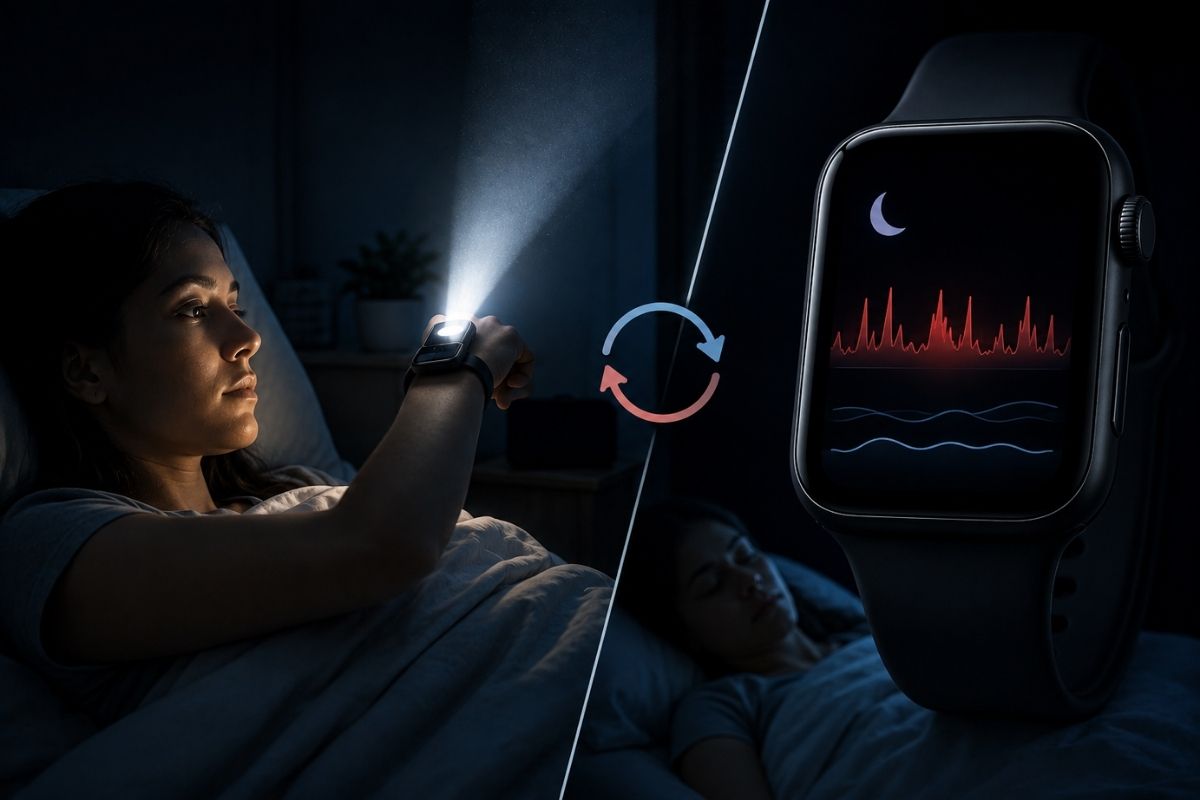
Using a smartwatch flashlight in the middle of the night blasts high-intensity blue light directly into your fully dilated pupils. This acute exposure suppresses melatonin production and elevates resting heart rate, actively sabotaging the exact sleep metrics the wearable is strapped to your wrist to measure.
The Melatonin Suppression Mechanism
When a smartwatch activates its flashlight feature, it pushes the OLED display to maximum brightness. To simulate a white beam, the screen forces its red, green, and blue sub-pixels to fire simultaneously. This emission heavily spikes in the 460- to 480-nanometer wavelength range.
These specific wavelengths directly overlap with the spectrum that suppresses melatonin, the hormone dictating circadian rhythms. Because pupils fully dilate in total darkness, a sudden 1,000-nit localized glare maximizes the biological impact. Research on intrinsically photosensitive retinal ganglion cells (ipRGCs) confirms that melanopsin-expressing retinal cells peak in sensitivity at exactly 480 nanometers. Striking these receptors with a bright OLED screen sends a severe biological signal to the brain that mimics daylight.
Algorithmic Self-Sabotage
Ironically, relying on a smartwatch as a midnight torch creates the poor physiological state the wearable then logs. Sleep algorithms categorize stages by analyzing resting heart rate, heart rate variability (HRV), and accelerometer data.
Intense nighttime light triggers an immediate autonomic nervous system response. Clinical studies demonstrate that acute nocturnal light exposure activates sympathetic autonomic tone, immediately elevating resting heart rate and worsening insulin resistance metrics. The smartwatch merely records this altered state. Activating a screen flashlight for just 30 seconds to navigate a dark hallway can generate elevated heart rate and physical restlessness metrics that persist for hours, effectively corrupting the night’s sleep score.
Software Filters vs. Hardware LEDs
Some manufacturers attempt to mitigate this biological response using software. A software-based red screen—like the implementation on the Apple Watch Ultra—fails to protect sleep architecture as effectively as a dedicated physical LED.
Switching a standard OLED matrix into a “red mode” disables the blue and green pixel channels, reducing overall blue light exposure. However, the display panel continues to bleed broader light spectrums. An OLED screen cannot fully isolate the narrow 660-nanometer band required to keep circadian rhythms intact. By contrast, devices like the Garmin Fenix or Instinct series bypass the display panel entirely by integrating dedicated hardware LEDs into the watch casing, offering true spectrally isolated illumination. Until hardware LEDs become the industry standard, users are forced to choose between navigating the dark safely and maintaining uncorrupted sleep data.