







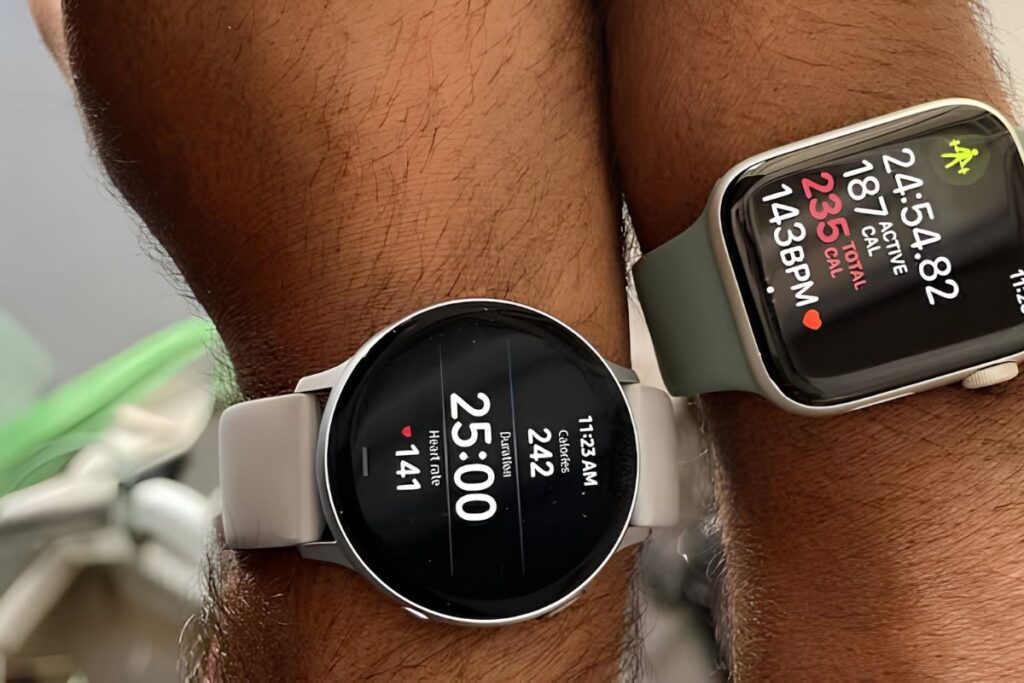
Following your Apple Watch’s prompt to increase lifting weight is medically risky. The new Apple Watch Gym Strength beta calculates progress solely by counting completed repetitions, ignoring whether your lifting form broke down. Medical professionals warn that increasing weight without evaluating biomechanical integrity directly causes joint injuries.
The watchOS 27.3 beta, the upcoming software update for Apple devices currently in developer testing, introduces a feature that explicitly tells users when to lift heavier weights. This algorithm actively increases the risk of acute gym injuries among novice lifters because it prescribes heavier loads while remaining completely blind to joint strain.
How does the Apple Watch Gym Strength algorithm trigger weight increases?
The watchOS 27.3 beta software triggers weight progression based purely on volume completion. If you log the target number of sets and reps on the screen, the watch commands a weight increase for your next session.
This mechanism violates a foundational rule of sports medicine. Form integrity must precede weight increases. Medical consensus dictates that adding intensity or load without verifying how the body moves under that weight leads to overexertion and physical harm.
Does the Apple Watch track lifting form?
No, the Apple Watch Gym Strength integration operates entirely through arithmetic. Tech outlets have noted that the Fitness+ integration allows users to tap their wrist to log a set and automatically generates a four-week workout plan.
Behind the scenes, the watch adheres to a simplified version of progressive overload, the practice of gradually increasing weight or reps in a strength routine. The Apple software operates on the assumption that completing ten repetitions today means you are physically ready for more weight tomorrow.
The National Strength and Conditioning Association (NSCA) standards clarify that progressive overload only applies when a lifter’s form stays strong. The current watchOS 27.3 algorithm cannot measure form.
What happens to your body when you follow the watch’s prompt while fatigued?
When a lifter attempts to satisfy a digital prompt to add weight while their nervous system is fatigued, the body actively compensates.
Load shifts away from the targeted muscle groups and directly onto vulnerable joints and connective tissues. Completing a repetition mathematically does not mean completing it safely.
As sports biomechanics research from Dr. Stuart McGill demonstrates, when core stability fails under a heavy barbell, shear and compressive forces spike. The spine loses its neutral position, transferring the weight to passive structures like discs and ligaments. Similar compensations during overhead presses push the physical load onto the rotator cuff.
Apple representatives point out that Gym Strength includes video demonstrations of proper form. The company maintains that users remain responsible for listening to their own bodies during workouts.
Can Apple be held liable for workout injuries?
Apple instructs users to lift heavier physical loads without having physical line-of-sight to the user’s environment. The software operates as a blind trainer, issuing commands without the ability to verify if the previous movement was executed correctly.
The company already builds extensive safety features into its hardware, including Fall Detection and Crash Detection, designed to alert authorities during physical emergencies. The Gym Strength beta contrasts directly with this approach by actively prescribing physical strain while relying entirely on user self-reporting to mitigate injury risk.
Could the Apple Watch measure lifting safety?
The Apple Watch already contains precision accelerometers and gyroscopes capable of measuring bar speed and lifting velocity, but the Gym Strength beta completely ignores this motion-sensor data.
Developers routinely use Apple’s Core Motion API, a software tool that tracks device orientation and movement in three-dimensional space, to track the exact rotation rate and acceleration of the wrist.
In athletic conditioning, coaches use these sensors for Velocity Based Training, a coaching method that tracks the physical speed of a barbell during a lift. When a lifter’s velocity drops, it signals central nervous system fatigue and mechanical breakdown. This drop in speed prompts the coach to stop the weight progression immediately.
The Gym Strength software ignores this data entirely. It relies exclusively on the user’s manual input of completed repetitions. Until the algorithm incorporates velocity metrics, a wrist vibration telling a novice to add ten pounds remains a hardware capability stripped of medical context.
Frequently Asked Questions
Does the Apple Watch Gym Strength app check my lifting form? No. The watchOS 27.3 beta relies entirely on the number of repetitions you manually log on the screen. It ignores biomechanical form, joint strain, and velocity, meaning it cannot tell if you lifted a weight safely or dangerously.
Why is it dangerous to increase weight based only on reps? Adding weight when your form is failing forces your body to compensate. This shifts the physical load away from your muscles and onto vulnerable joints, directly leading to injuries like rotator cuff tears or spinal disc compression.
Does the Apple Watch hardware have the ability to track workout safety? Yes. The Apple Watch contains precision accelerometers and gyroscopes that can track lifting velocity, which is a key clinical indicator of physical fatigue. However, Apple’s current Gym Strength software does not use this motion-sensor data to gatekeep weight progression.