






Approved power allocations face widespread data center grid connection delays because high-voltage step-up transformers face delivery wait times of roughly 156 weeks. A worldwide deficit in specialized electrical steel prevents manufacturers from accelerating production, leaving multi-gigawatt computing projects physically unable to draw power from regional utility transmission networks before 2028.
A high-voltage step-up transformer is a multi-ton electromagnetic unit that converts transmission-level voltage down to distribution levels usable by commercial computer servers. A developer can clear state regulatory reviews, sign utility contracts, and secure construction debt, but none of those milestones supply electricity without this physical hardware in place.
Why Are Datacenters Facing 156-Week Transformer Lead Times?
Datacenters face 156-week transformer lead times because domestic manufacturing capacity is fully booked while custom manual winding requirements prevent factories from accelerating production schedules.
Procurement lead times for custom Large Power Transformers have expanded from an average of roughly 52 weeks in 2021 to 156 weeks today. That represents three full calendar years from purchase order execution to delivery on a concrete pad. According to supply chain reviews published by the United States Department of Energy Electric Grid Supply Chain Review, custom engineering specifications, high-voltage insulation requirements, and skilled labor deficits have stretched production queues far past historical baselines.
This delivery gap decouples administrative approvals from physical operation. When regional grid operators approve an interconnection, the paperwork certifies that transmission lines can carry the load. It does not certify that the facility possesses the transformers required to link to those circuits.
As documented in substation assessments from the National Renewable Energy Laboratory Grid Modernization Assessments, multi-year transformer backlogs routinely strand sites where physical grading, switchgear yards, and transmission line ties stand finished.
How Does the Electrical Steel Deficit Restrict Global Transformer Production?
The electrical steel deficit restricts global transformer production because a small cluster of specialized mills cannot expand output of the magnetic iron cores required inside high-voltage units.
The primary mechanical bottleneck is grain-oriented electrical steel, an iron-silicon alloy engineered with uniform crystal structures to conduct electromagnetic fields with minimal thermal energy loss. Every high-voltage step-up transformer requires this alloy for its internal core.
There is zero idle domestic surge capacity. In the United States, production relies on a single domestic producer: Cleveland-Cliffs.
Federal evaluations under the United States Department of Commerce Section 232 Steel Reports and mineral tracking by the United States Geological Survey Mineral Commodity Summaries establish that domestic electrical steel mills cannot meet existing domestic infrastructure demand. This imbalance leaves the American power grid dependent on tightly allocated foreign supply chains.
Building new electrical steel capacity requires cold-rolling mills with extreme mechanical tolerances and high-temperature decarburization furnaces that take three to five years to permit and build. Consequently, domestic transformer builders rely on imports from a handful of mills in Japan and Germany where order books are already filled by local grid modernizations. Trade data compiled by the United States International Trade Commission DataWeb indicates that imports under Harmonized Tariff Schedule Codes 7225 and 7226 face strict trade allocations and long maritime freight queues.
Why Do Corporate Energization Dates Contradict Import Manifests?
Corporate energization dates contradict import manifests because customs records show that shipments of high-capacity transformers match less than 35% of the power capacity tech companies promised to activate by 2027.
Corporate filings from major technology hyperscalers routinely project commercial online dates for new computing clusters within 18 to 24 months of groundbreaking. Physical trade manifests tell another story. Liquid dielectric transformers designed for heavy industrial use, tracked under United States Harmonized Tariff Schedule Code 8504.23, arrive at domestic ocean ports at volumes far below stated commercial targets.
Import shipping manifests cataloged by Descartes Datamyne HTS 8504.23 Trade Manifests demonstrate that incoming high-voltage units match less than 35% of the total substation capacity scheduled for near-term corporate energization.
This gap between public operational schedules and incoming equipment has produced an active secondary market. Market reports from Wood Mackenzie Power & Renewables Research show that private developers are paying transformer secondary market premiums of 200% to 300% to acquire existing factory slots or surplus units from abandoned industrial projects.
Technology operators counter that they are directly addressing supply chain frictions. Several hyperscalers are funding manufacturing expansions with upfront capital, signing multi-year production reservations, and shifting toward standardized substation layouts to reduce custom design times.
How Does Commercial Procurement Deplete Public Utility Spare Reserves?
Commercial procurement depletes public utility spare reserves by redirecting factory production slots toward private developers who outbid regulated utility budgets.
Regulated electric utilities purchase transformers through multi-year capital plans approved by state public utility commissions. These statutory procurement budgets rarely accommodate sudden emergency price premiums.
Joint filings compiled by the American Public Power Association Supply Chain Working Group and the Edison Electric Institute Regulatory Filings warn that commercial queue-jumping has drawn down utility spare transformer stockpiles to precarious levels.
When private developers pay cash premiums to lock up manufacturing queues, public utilities wait longer for basic equipment replacements. A delivery delay for a commercial data center defers corporate income. For an electric utility, that same delay leaves fewer replacement transformers on hand if severe weather takes out a regional substation.
Substation upgrade delays documented before state regulators, including the Virginia State Corporation Commission Public Utility Dockets, show that routine utility grid projects are deferred because equipment manufacturers cannot guarantee delivery dates.
Why Can’t New Factory Announcements Clear the Backlog Before 2028?
New factory announcements cannot clear the backlog before 2028 because heavy electrical manufacturing plants require two to three years of construction, specialized tooling installation, and technical certification before shipping their first transformer.
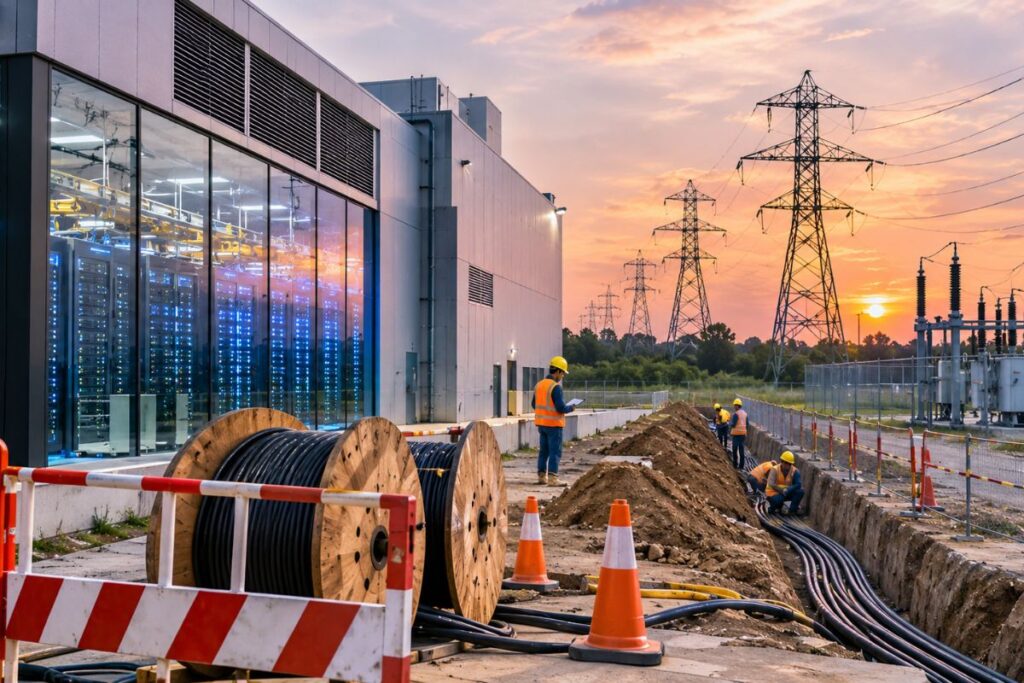
Billions of dollars in completed civil engineering work remain parked across major tech regions. Concrete pads, perimeter fences, and high-voltage line connections sit finished, waiting on central step-up transformers that remain unbuilt in factory queues.
Announced manufacturing expansions will eventually add supply, but they provide zero immediate relief. Factory commissioning schedules from the Siemens Energy Charlotte Large Power Transformer Project confirm that new domestic manufacturing facilities require 24 to 36 months for site construction, precision winding machine setup, and IEEE electrical certification before shipping commercial units.
The mechanical reality of custom heavy manufacturing means current order backlogs cannot clear before 2028. Grid access belongs not to the companies holding the earliest regulatory permits, but to the entities that possess physical delivery receipts for high-voltage iron.
Frequently Asked Questions
What is causing datacenter grid connection delays?
Datacenter grid connection delays are caused by an acute shortage of high-voltage step-up transformers, where delivery wait times have expanded from 52 weeks to 156 weeks. Even after securing utility and regulatory approvals, developers cannot link computer servers to transmission lines without this custom machinery.
Why is there a shortage of large power transformers?
The shortage is driven by a global deficit of grain-oriented electrical steel, a specialized alloy required to build transformer cores. Domestic manufacturing depends almost entirely on a single steelmaker, Cleveland-Cliffs, while foreign mills in Japan and Germany are already booked with their own regional grid projects.
How does commercial transformer demand affect everyday electric utilities?
Commercial tech developers are paying secondary market cash premiums of 200% to 300% to jump factory order lines. This outbidding pulls manufacturing capacity away from regulated utilities, depleting emergency spare stockpiles needed to restore power after major storms.
When will the high-voltage transformer shortage end?
The backlog will not clear before 2028. Building new transformer factories and specialized steel-rolling mills requires 24 to 36 months of construction, precision tooling, and IEEE certification before new commercial units can be shipped.