







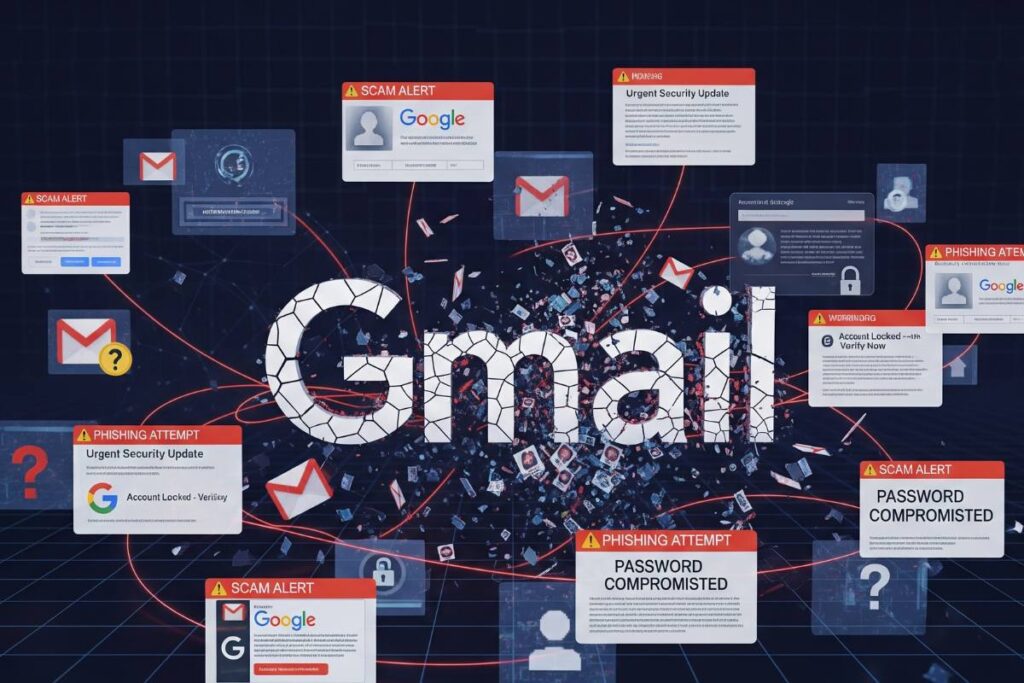
Google has acknowledged an unauthorized intrusion into an internal corporate Salesforce CRM instance orchestrated by the threat actor tracked as UNC6040, a group frequently aligned with the “ShinyHunters” cybercrime collective. While consumer infrastructure—including Gmail inboxes, Google Drive storage, and Google Cloud production environments—remained unbreached, the exfiltration of enterprise contact directories has catalyzed an aggressive global wave of voice-phishing (vishing) and credential harvesting campaigns targeting both enterprise Workspace administrators and consumer accounts.
Intrusion Scope: Corporate CRM vs. Core Infrastructure
The initial breach occurred in June when UNC6040 gained transient access to a Salesforce database utilized by Google’s business development and sales teams. Threat actors exfiltrated client contact details, corporate communications, and commercial notes before administrators isolated the compromised tenant. Google completed direct disclosures to impacted commercial entities by early August.
Public confusion mounted following media headlines suggesting Gmail’s global user base had been compromised. A structural breakdown clarifies the perimeter boundary of the incident:
| Infrastructure Perimeter | Data Classification | Compromise Status |
|---|---|---|
| Google Corporate Salesforce | Business contacts, sales records, client notes | Compromised: Unauthorized exfiltration via bulk export |
| Consumer Gmail & Workspace | User inboxes, Google Drive, Calendar data | Secure: Isolated on distinct production infrastructure |
| Authentication & Passwords | Account passwords, cryptographic hashes, salts | Secure: No direct database leak; secondary phishing target |
Attack Mechanics: UNC6040 and Social Engineering Playbooks
Google Threat Intelligence identified UNC6040 utilizing automated API export utilities—including Salesforce’s native Data Loader alongside custom Python scripts routed through virtual private networks and Tor relays—to harvest directories rapidly. Rather than attempting to breach Google’s central identity provider directly, the attackers weaponized the stolen directory data for targeted pretexting.
The subsequent campaigns employ sophisticated telephony manipulation. Attackers spoof inbound caller identification to emulate Google’s Mountain View exchange (+1-650). Impersonating Google IT Support or corporate security liaisons, operatives contact targets claiming an urgent security violation is actively compromising their account. Victims are directed to real-time reverse-proxy phishing pages designed to intercept session cookies, passwords, and multi-factor authentication (MFA) tokens on the fly.
Compounding this activity, an adjacent supply-chain campaign exploited compromised OAuth authorization tokens within third-party Salesloft and Drift integrations, systematically auditing connected applications to achieve lateral movement across enterprise CRM clusters.
Deconstructing the “2.5 Billion Users” Threat Vector
While the figure of 2.5 billion Gmail users represents the global footprint of Google’s email ecosystem rather than a verified leak count, the scale illustrates the blast radius of weaponized social engineering. In mass credential-harvesting operations, attackers do not require direct database access; public reporting of a “Google breach” provides sufficient psychological leverage to induce compliance in non-technical users.
When recipients believe Google’s systems have already been compromised, urgent requests to “verify identity” or “re-authenticate security keys” appear credible. Stolen corporate directories provide the corroborating context—such as colleague names, internal vendor references, and business phone numbers—needed to deceive even vigilant corporate staff.
Enterprise Hardening and Authentication Remediation
The incident highlights the operational vulnerabilities inherent in third-party software-as-a-service (SaaS) integrations. Security teams and individual administrators must adjust defense postures across multiple control layers:
- SaaS Permission Auditing: Restrict Salesforce administrative capabilities by revoking broad
API Enabled,Customize Application, andManage Connected Appspermissions. Mandate strict IP range restrictions on API queries. - OAuth Token Revocation: Audit third-party application consents and revoke legacy OAuth authorizations across messaging, scheduling, and analytics integrations.
- Migration to Phishing-Resistant MFA: Deprecate SMS-based verification and push-notification approvals in favor of FIDO2/WebAuthn hardware security keys and biometric passkeys, which render reverse-proxy credential harvesting ineffective.
Related Technology Intelligence & Hardware Benchmarks
- Anthropic Claude Outage Halts Workflows, Exposing Tech’s Generative AI Dependency
- Google Halts DeepMind Fundamental Science Projects to Reallocate TPUs for Gemini
- TruthUpfront Enterprise Economics & Labor Realignment Intelligence
Technical Standards & Empirical Frameworks
- NIST Cybersecurity & AI Risk Management Framework (AI RMF): https://www.nist.gov/itl/ai-risk-management-framework
- IEEE Computer Society & ACM Digital Computing Standards: https://www.ieee.org/