






While India’s non-smartphone electronics exports, medical instruments, and aerospace components grew between FY22 and FY27, official government assessments and trade data show that domestic value addition across electronics remains between 18% and 20%. Rising outbound shipments rely heavily on parallel inflows of imported sub-assemblies and specialty inputs.
How Much Value Do India Non-Smartphone Electronics Exports Retain Locally?
According to NITI Aayog and Press Information Bureau disclosures, domestic value addition across India’s electronics sector stands at 18% to 20%, meaning roughly 80 cents of every exported dollar still corresponds to imported components, wafers, and sub-assemblies.
Official trade figures from the Ministry of Commerce and Industry show India’s non-smartphone electronics exports rose 56.5% in the first half of FY27 (April–September 2026), from $8.81 billion a year earlier to $13.79 billion. That expansion pushed the non-smartphone share of India’s total electronic exports from 39.7% to 43.2%.
Comparing those gross border numbers with sector-wide production data reveals a wide gap between outbound cargo receipts and local economic retention. Across India’s electronics sector, which reached $156.39 billion (Rs. 12 lakh crore) in production and $43.01 billion (Rs. 3.30 lakh crore) in exports in FY25, domestic value addition edged up from 15% to 18% in FY23 to 18% to 20% in FY25.
That gap between gross export receipts and net domestic retention is widest in circuit boards, memory modules, and telecom hardware.
Which Products Drive India’s Telecom and Circuit Board Export Surge?
Disaggregated customs data reported by DD News from Ministry of Commerce and Industry records show that mounted printed circuit boards, network transmission gear, and memory integrated circuits accounted for the fastest outbound growth in April–September 2026.
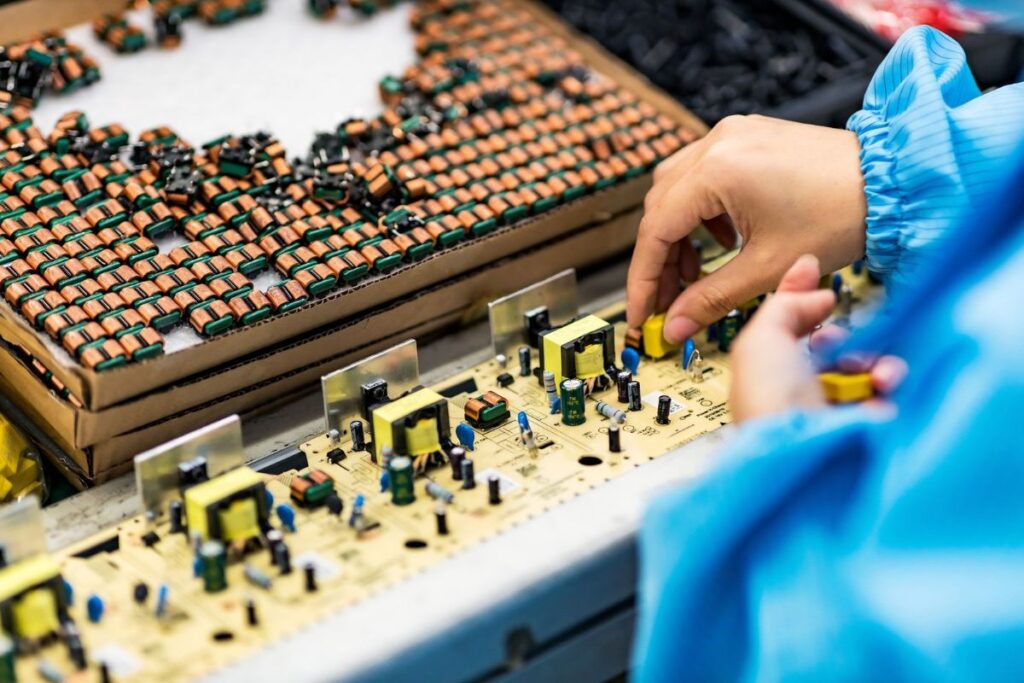
- Mounted printed circuit boards (parts and accessories): Exports jumped 3,219%, rising from $63.3 million to $2.10 billion, with Singapore absorbing $1.87 billion and China taking $111.5 million.
- Populated or stuffed printed circuit boards: Shipments rose 304%, from $213.7 million to $864.1 million, with $789.2 million shipped directly to China.
- Network transmission and routing equipment: Exports nearly doubled, up 98% from $732.9 million to $1.45 billion, led by shipments to Hong Kong ($857.7 million), the United States ($130.9 million), and the Netherlands ($124.4 million).
- Memory integrated circuits: Outbound shipments climbed 2,333%, from $23.1 million to $562.4 million, led by Malaysia ($390.8 million) and Singapore ($102.4 million).
Broader customs profiles compiled by the Directorate General of Commercial Intelligence and Statistics (DGCI&S) under ITCHS 8517, the Indian Trade Classification Harmonized System code covering telephones, cellular network gear, and wired or wireless communication apparatus, show that India exported $22.08 billion in this group in 2024, accounting for 4.99% of the nation’s total export basket.
Corporate filings from major Production-Linked Incentive (PLI) scheme beneficiaries, government programs that disburse cash payouts tied to incremental domestic sales, show how domestic assembly scales alongside global supply links. In its FY25 Annual Report, Tejas Networks reported net revenues of Rs. 8,923 crore (up 261% year-on-year) and Rs. 312 crore in cumulative PLI incentives for FY24 and H1 FY25 after supplying baseband and radio gear for over 100,000 cell sites. Meanwhile, HFCL Limited’s FY25 Annual Report shows that while the company manufactures optical fiber and cables domestically, only 16% of its direct input materials were sourced from domestic micro, small, and medium enterprises (MSMEs).
Why Do Gross Export Figures Overstate Domestic Manufacturing Depth?
Gross customs figures overstate domestic manufacturing depth because border statistics record the full price of a finished export, including re-exports, even when up to 80% of its internal silicon and sub-assemblies were imported from abroad.
Monthly trade releases from the Ministry of Commerce and Industry measure export performance using gross Free-on-Board (FOB) shipment values, the total border price of goods loaded onto a vessel or aircraft for export, including re-exports as noted in Directorate General of Commercial Intelligence and Statistics trade profiles. Because customs authorities record the full border value of a finished router or populated circuit board, gross totals treat final-stage assembly identically to end-to-end domestic manufacturing.
Trade economists isolate actual local economic contribution through Domestic Value Addition (DVA), the share of a product’s final export price generated by local labor, engineering, utilities, and domestically produced inputs. According to the Organisation for Economic Co-operation and Development (OECD) Trade in Value Added (TiVA) 2026 edition and methodology studies from the Centre for WTO Studies, gross customs figures mask import dependence in economies specializing in downstream assembly. In its July 2024 global value chain report, NITI Aayog reported that while India produced $101 billion in electronics in FY23, only $15 billion came from domestic component manufacturing compared to $86 billion in finished goods assembly.
Grouping all non-smartphone exports under a single headline also obscures sharp operational differences between engineering sectors.
How Do Aerospace Parts and Medical Device Exports Differ in Local Value?
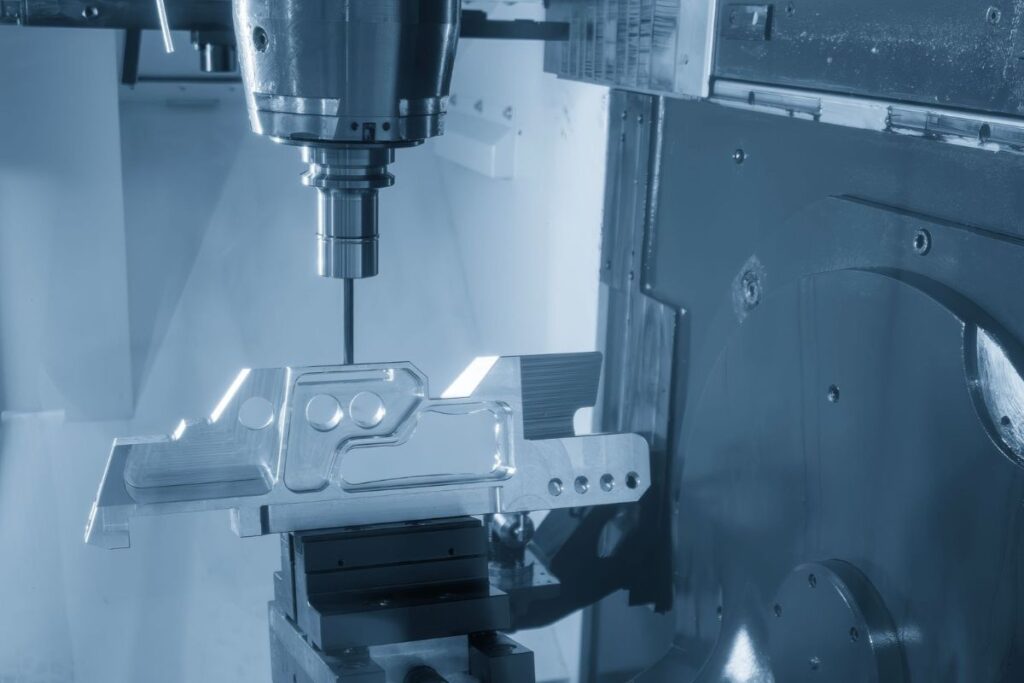
Aerospace part exports (HSN 8803) capture high local engineering value through precision alloy machining, whereas medical device exports (HSN 9018) rely on imports for 70% to 80% of advanced diagnostic and therapeutic hardware.
In aerospace components (HSN 8803), export growth relies on tight-tolerance metal machining, titanium and superalloy castings, and structural airframe parts. Shipping manifest data tracked by Volza shows Indian suppliers shipping airframe sub-assemblies, rudder links, and autopilot module housings (HSN 88033000 and 88039090) to global aviation buyers. Sector analysis from SOIC Research reports that private Indian Tier-1 aerospace suppliers, such as PTC Industries (which generates 82% of revenue from exports) and Azad Engineering, convert raw alloy inputs into precision-machined engine and structural parts domestically, even as state-owned Hindustan Aeronautics Limited relies on imports for over 75% of its raw materials.
Medical devices (HSN 9018) follow a far more import-dependent structure. While the Directorate General of Commercial Intelligence and Statistics tracks growing outbound shipments of medical, surgical, and electro-diagnostic instruments under HSN 9018, a November 2026 NITI Aayog policy roadmap summary confirms that India still relies on imports for 70% to 80% of its advanced diagnostic and therapeutic equipment. Domestic plants manufacture consumables, disposables, and basic assemblies, while high-value imaging tubes, sensors, and diagnostic sub-modules continue to arrive from overseas vendors.
Whether those imported modules eventually shift to domestic factories depends largely on how India calibrates its customs duties and subsidy rules.
How Do Tariff Waivers and Localization Rules Shape Future Value Addition?
India pairs extended customs duty waivers on imported sub-assemblies with a Rs. 40,000 crore component manufacturing scheme and tighter public procurement rules to build assembly scale first before forcing local sourcing.
In July 2026, as reported by ET Electronics World, the government extended customs duty exemptions on key electronic sub-assemblies and capital goods, targeting industrial, automotive, and medical applications, to lower input costs for domestic plants. Separately, the Union Receipt Budget 2026–27 tracks the fiscal revenue foregone across conditional customs duty exemptions granted to promote export competitiveness.
Policymakers and industry bodies maintain that high initial import intensity is a standard phase in global value chain integration. In its November 2026 Impact Assessment of PLI Schemes, NITI Aayog stated that Large Scale Electronics Manufacturing (with an outlay of Rs. 34,193 crore) built initial assembly scale and laid the groundwork for the Rs. 40,000 crore Electronics Component Manufacturing Scheme (ECMS), while noting that telecom and advanced components still require deeper domestic value addition. Similarly, a tariff study by the Indian Council for Research on International Economic Relations (ICRIER) concluded that integrating with global value chains requires low input tariffs in the short run so domestic plants can achieve export scale before attracting upstream component suppliers.
Yet tariff design creates a recurring policy trade-off. An India Cellular & Electronics Association (ICEA) tariff comparison report found that while export-oriented units use duty-free import windows such as Advance Authorisation and the Manufacture and Other Operations in Warehouse Regulations (MOOWR) to bypass high tariffs on components, raising duties prematurely under the Ministry of Electronics and Information Technology’s (MeitY) Phased Manufacturing Programme (PMP) increases production costs if local component ecosystems lack scale. To tighten localization standards, MeitY revised its Public Procurement (Preference to Make in India) Order in November 2026 across six IT hardware categories, setting up a direct test over the next 24 months of whether India’s $13.79 billion non-smartphone export engine can raise domestic value addition beyond the 20% ceiling.
Frequently Asked Questions
How much of India’s electronics export value is actually created inside India?
According to NITI Aayog and Press Information Bureau disclosures, domestic value addition across India’s electronics sector is 18% to 20%, up from 15% to 18% in FY23. That means roughly 80 cents of every dollar of exported electronics corresponds to imported components, wafers, and sub-assemblies.
Which products are driving India’s non-smartphone electronics export growth?
Ministry of Commerce and Industry data for April–September 2026 shows that mounted printed circuit boards ($2.10 billion, up 3,219%), network transmission and routing equipment ($1.45 billion, up 98%), populated printed circuit boards ($864.1 million, up 304%), and memory integrated circuits ($562.4 million, up 2,333%) led the expansion.
Why do Indian aerospace exports retain more domestic value than medical device exports?
Private Indian aerospace suppliers such as PTC Industries and Azad Engineering machine raw titanium and superalloy inputs into tight-tolerance structural and engine parts domestically, capturing high local engineering hours. In contrast, a November 2026 NITI Aayog roadmap confirms that India imports 70% to 80% of advanced diagnostic and therapeutic medical hardware, limiting local plants largely to consumables and final assembly.
How is the Indian government trying to increase domestic component manufacturing?
Alongside customs duty exemptions extended in July 2026 to keep assembly plants cost-competitive, the government launched the Rs. 40,000 crore Electronics Component Manufacturing Scheme (ECMS). It revised its Public Procurement (Preference to Make in India) Order in November 2026 across six IT hardware categories.