






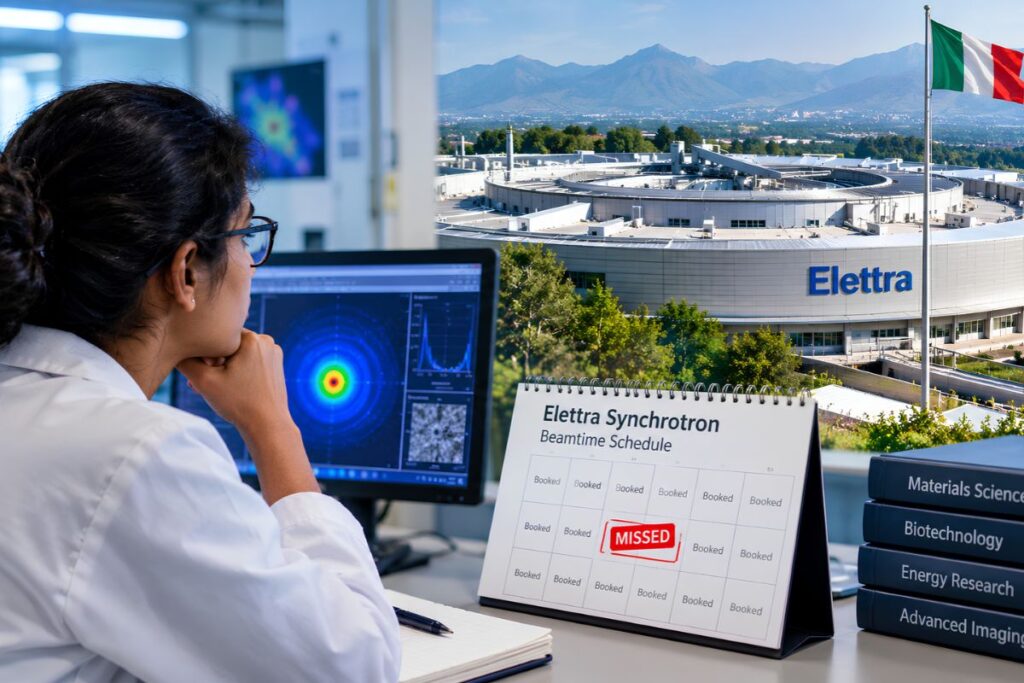
India commits public funds through the Department of Science and Technology (DST) to secure India Elettra Synchrotron beamtime in Italy, yet domestic grant delays and institutional bottlenecks leave many researchers struggling to use those slots. While elite national institutes capture the bulk of the access, state university scientists face steep administrative hurdles after winning scientific approval.
How Much Transparency Exists Around India’s Elettra Synchrotron Bill?
Government budget disclosures bundle international mega-science payments into broad cooperation accounts rather than publishing shift-by-shift utilization audits for India Elettra Synchrotron beamtime. This accounting structure prevents taxpayers from seeing how much paid experimental time at Elettra Sincrotrone Trieste, an Italian particle accelerator facility that generates intense X-ray beams to examine materials at the atomic scale, goes unused each cycle.
According to DST Annual Reports and facility records managed by the Elettra User Office, New Delhi maintains an ongoing annual institutional commitment to the Trieste facility under a bilateral access arrangement. Under the Union Budget Demand for Grants for the Department of Science and Technology, international mega-science outlays sit under aggregated cooperation heads instead of line-by-line beamline utilization reports. Diplomatic announcements continue to frame the Trieste facility as a fresh frontier rather than an existing taxpayer-funded commitment requiring operational oversight.
What Did Mainstream Coverage Miss About the November 2026 Trieste Visit?
Mainstream coverage missed that India’s formal scientific access to Elettra Sincrotrone Trieste has operated for over a decade rather than starting with Union Minister Dr. Jitendra Singh’s November 11–15, 2026 visit. Official Press Information Bureau (PIB) readouts tie the trip to the Special Strategic Partnership signed during Prime Minister Narendra Modi’s May 2026 visit to Italy, presenting Dr. Singh’s stops at Elettra, the Abdus Salam International Centre for Theoretical Physics (ICTP), and the International Centre for Genetic Engineering and Biotechnology (ICGEB) as a brand-new push in frontier research.
In practice, India’s partnership with Elettra runs through the DST International Cooperation Division and dedicated beamline agreements, including specialized X-ray diffraction and photoemission stations such as the Xpress high-pressure diffraction beamline and XRD2 beamline. Indian physicists and chemists have long competed for “beamtime”, the strictly scheduled hours during which a research team directs the synchrotron’s X-ray beam onto a physical sample.
Why Do Indian Scientists Forfeit Approved Elettra Synchrotron Beamtime?
Indian researchers risk losing approved Elettra beamtime because scientific peer review in Italy is separated from domestic travel-grant disbursements in India. Winning experimental hours through Elettra’s technical review panel does not include funding for international flights, accommodation, or specialized sample transport.
Securing access follows a two-stage sequence that frequently stalls at the second step:
- A scientist submits a research proposal through the Elettra Virtual Unified Office (VUO), where an international panel grades the project solely on scientific merit.
- Once approved, the researcher must apply separately to domestic bodies, including the DST, the Anusandhan National Research Foundation (ANRF), or nodal reimbursement desks, for travel funds, daily living stipends, and cold-chain shipping, while simultaneously applying for Schengen research visas through the Embassy of Italy in New Delhi.
When domestic grant sanctions lag behind Elettra’s twice-yearly scheduling calendar (with proposal deadlines typically falling on March 15 and September 15), researchers miss their assigned experimental window. Because synchrotron beamlines run 24 hours a day on fixed international timetables, a forfeited slot cannot simply be rolled over to a later month.
Which Indian Institutions Actually Use the Trieste Beamtime?
User rosters documented in Elettra Scientific Highlights and User Reports show that Indian participation is heavily concentrated among a small group of premier national research centers rather than state universities.
Institutions such as the Indian Institute of Science (IISc) and established Indian Institutes of Technology maintain dedicated international travel cells and internal contingency funds. Faculty at these centers can advance airfare and shipping costs from institutional accounts while waiting for central reimbursement, a financial buffer unavailable to professors at most state universities tracked under the All India Survey on Higher Education (AISHE).
DST program guidelines state that high-energy synchrotron experiments require specialized sample preparation and prior technical training, making concentration at major research hubs practical. To widen participation, the department coordinates training and mail-in sample programs, allowing scientists to ship samples to Italy instead of traveling, through nodal agencies including the Saha Institute of Nuclear Physics (SINP) and the UGC-DAE Consortium for Scientific Research.
How Will the Elettra 2.0 Upgrade Affect Indian Access After 2026?
Elettra Sincrotrone Trieste’s scheduled transition to Elettra 2.0, a fourth-generation diffraction-limited storage ring engineered to generate far brighter X-ray beams, will temporarily narrow physical beamtime availability immediately following Dr. Singh’s November 2026 visit.
According to the Elettra 2.0 Upgrade Roadmap, machine installation and commissioning phases restrict active beamline operations before upgraded stations open to full user schedules. Unless New Delhi pairs its diplomatic renewal with automatic travel-grant disbursement upon VUO peer-review approval, and scales up mailed-sample remote protocols, the upgraded Italian accelerator risks inheriting the same domestic bottleneck.
Frequently Asked Questions
How do Indian scientists get beamtime at Italy’s Elettra Synchrotron? Indian researchers submit technical proposals twice a year (typically by March 15 and September 15) through the Elettra Virtual Unified Office, where an international panel grades projects on scientific merit. Once approved, scientists must separately apply to Indian agencies such as the Department of Science and Technology (DST) or nodal university coordinators for travel and sample-shipping reimbursements.
Why do some Indian researchers miss their scheduled slots at Elettra Sincrotrone Trieste? Scientific approval from Elettra does not automatically release travel money in India. When domestic travel-grant sanctions or Schengen research visa approvals fall behind Elettra’s fixed six-month beamline schedule, researchers cannot reach Trieste in time, and forfeited hours cannot be rescheduled to the next month.
Which Indian institutions use the Elettra Synchrotron the most? According to Elettra user reports and publication records, Indian beamtime is concentrated among premier national institutions such as the Indian Institute of Science (IISc) and established Indian Institutes of Technology. These institutes have internal contingency funds to advance travel costs before central reimbursement arrives, unlike most state universities.
What is Elettra 2.0 and how does it affect India-Italy science cooperation? Elettra 2.0 is a fourth-generation upgrade of the Trieste storage ring designed to produce brighter X-ray beams for atomic-level research. Under the Elettra 2.0 Upgrade Roadmap, facility installation and commissioning will temporarily tighten physical beamtime availability after November 2026 before expanded capacity comes online.