






Core Architecture: RF Induction Meets Optical Matrices
The fundamental difference between NFC and QR codes rests in their physical transmission layers. NFC (Near Field Communication), governed by ISO/IEC 14443 and 18092 standards, uses high-frequency magnetic inductive coupling at precisely 13.56 MHz. With a maximum effective range of 4 centimeters, an NFC-enabled smartphone acts as the active transceiver. Its electromagnetic field powers a passive silicon tag, instantly retrieving an NDEF (NFC Data Exchange Format) message.
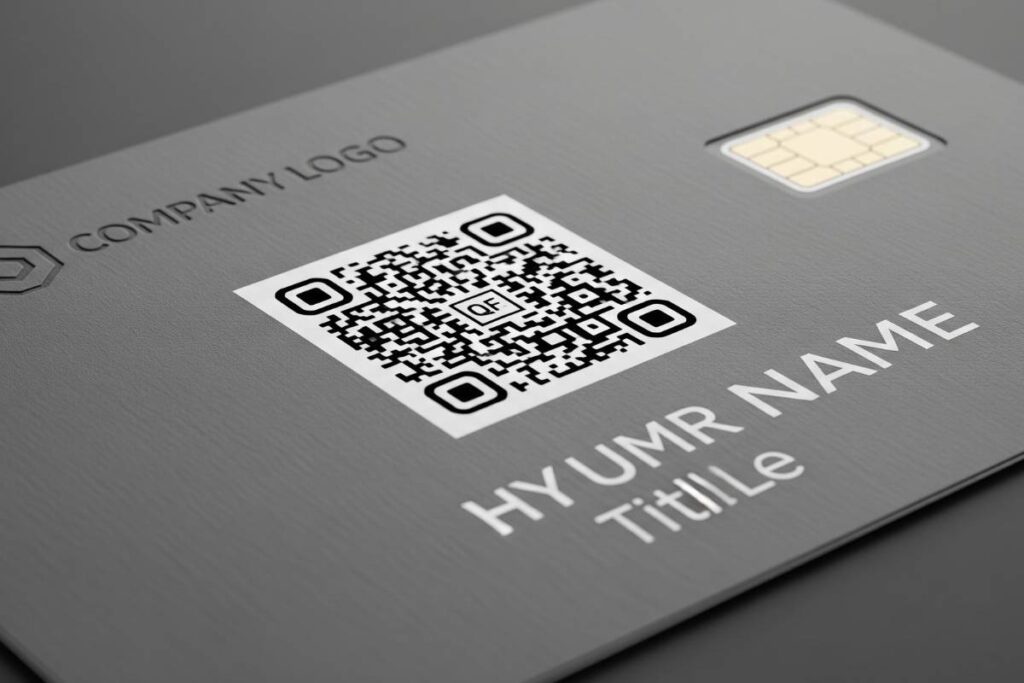
Conversely, QR (Quick Response) codes are two-dimensional optical matrix symbologies regulated by ISO/IEC 18004. They rely on machine vision. A device’s CMOS image sensor captures the square modules, identifying three distinct corner finder patterns to correct rotation, tilt, and perspective distortion before extracting the underlying data.
Silicon Specs: Breaking Down the NXP NTAG Series
Physical NFC enterprise cards depend almost entirely on NXP Semiconductors’ NTAG series. Choosing the wrong microchip introduces severe user experience friction:
- NXP NTAG213 (144 Bytes): Best suited for simple, compressed URL redirects—such as pointing an executive to a hosted corporate directory profile. It lacks the capacity to store a raw, uncompressed vCard containing multiple contact fields.
- NXP NTAG215 (504 Bytes): A mid-tier option that supports basic contact data or extended URLs equipped with complex analytics tracking parameters.
- NXP NTAG216 (888 Bytes): The enterprise benchmark for offline contact storage. This chip holds a complete RFC 6350 vCard 4.0 profile natively. It allows instant address-book saves even without an active cellular or Wi-Fi connection, making it ideal for underground convention centers or secure defense sector facilities (SCIFs).
Security Threat Vectors: Quishing and Tag Spoofing
Both data exchange methods introduce unique attack surfaces requiring evaluation by Chief Information Security Officers (CISOs) prior to enterprise-wide rollout.
1. QR Code Vulnerabilities: Quishing
Because optical matrices are illegible to the human eye, QR codes frequently serve as vectors for QR Code Phishing, or “quishing.” Agencies like CISA and the FBI routinely warn organizations about malicious QR stickers layered over legitimate printed media or physical conference badges. A compromised QR code can seamlessly redirect users to an adversarial reverse-proxy credential harvester, convincingly mimicking a Microsoft 365 or Okta login portal.
2. NFC Vulnerabilities: Tag Cloning
Standard, unencrypted NTAG213 and NTAG216 chips are vulnerable to passive cloning via handheld RFID transceivers, such as the Flipper Zero. An attacker in close proximity can copy the NDEF record and replicate the card. To block unauthorized duplication and ensure authenticity, high-security organizations issue NXP NTAG 424 DNA chips. These advanced chips generate a Secure Unique NFC (SUN) message relying on symmetric AES-128 cryptographic tokens that rotate on every tap. The receiving server validates the cryptographic MAC, confirming the tap originated from authorized corporate hardware.
Enterprise Fleet Management
Managing physical contact cards for thousands of distributed employees creates massive administrative overhead when job titles or office locations shift. Modern enterprise architectures bypass this by linking dynamic cloud redirects directly to identity providers (IdPs):
- SCIM and Entra ID Sync: Central platforms sync with Microsoft Entra ID via System for Cross-domain Identity Management (SCIM). When HR offboards an employee, the system instantly revokes their digital business card URL, redirecting scanners to a corporate 404 page or company homepage.
- Dynamic Virtual Wallet Passes: Moving beyond physical hardware entirely, organizations use Mobile Device Management (MDM) platforms to push cryptographic digital credentials to Apple Wallet and Google Wallet. These digital passes display dynamic QR codes, eliminating printing latency and hardware acquisition costs.
The Hybrid Standard for 2026
Relying exclusively on either NFC or QR codes generates unnecessary operational friction. The most resilient enterprise architecture utilizes a Dual-Layer Hybrid Standard:
- Physical Layer: A premium, branded physical card embedding an NTAG216 or NTAG 424 DNA chip programmed with a dynamic HTTPS redirect URL.
- Visual Fallback: A high-contrast, laser-etched dynamic QR code featuring Level M (15%) or Level Q (25%) Reed-Solomon error correction on the card’s reverse side. This guarantees scanability if the recipient’s phone has NFC disabled or uses a dense magnetic case that blocks RF signals.
- Digital Fleet Layer: Automated, company-wide deployment of Apple and Google Wallet passes via MDM, guaranteeing every employee carries an instantly accessible contact credential directly on their smartphone lock screen.
Related Technology Intelligence & Hardware Benchmarks
- DPDP Act Parental Consent on Android: Why Age Gates Fail
- Google Gemini Deep Research: How Agentic AI Automates Complex Analysis
- TruthUpfront Enterprise Economics & Labor Realignment Intelligence
Technical Standards & Empirical Frameworks
- NIST Cybersecurity & AI Risk Management Framework (AI RMF): https://www.nist.gov/itl/ai-risk-management-framework
- IEEE Computer Society & ACM Digital Computing Standards: https://www.ieee.org/