






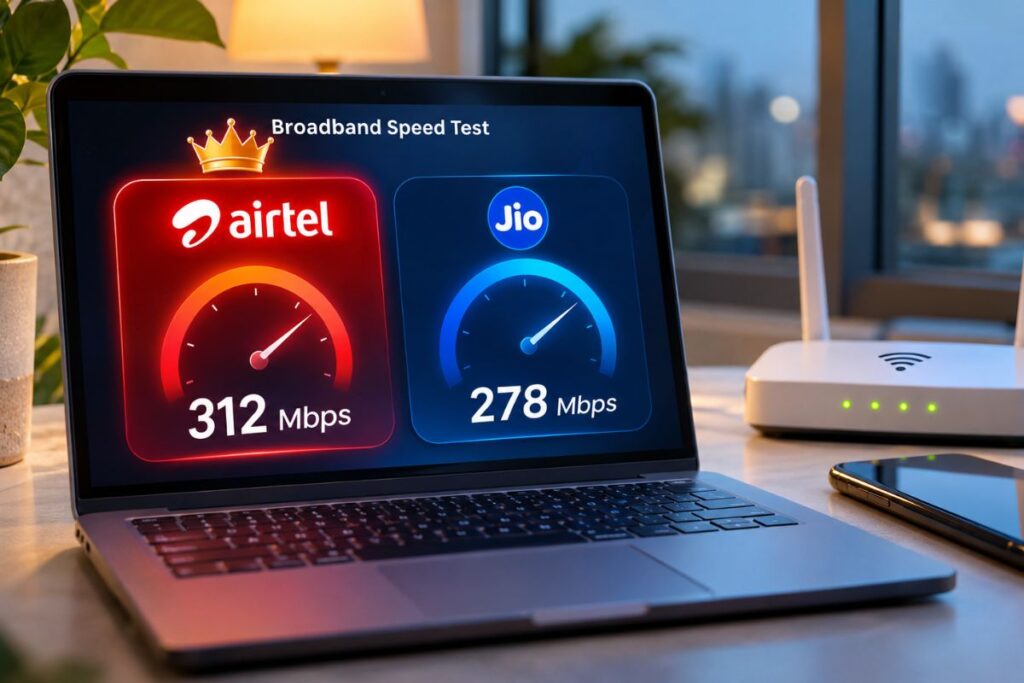
Airtel beat Reliance Jio in broadband speed tests by sharply limiting new user onboarding, keeping its network less congested while Jio absorbed massive traffic surges. Crowdsourced speed tests measure conditions on active connections, and Airtel’s connections were fast because fewer households shared the same radio cells.
Why Did Airtel Win Speed Awards While Adding Fewer Customers?
In November 2026, mobile analytics firm Opensignal awarded Bharti Airtel top marks across all five categories in its India Fixed Broadband Experience report. The headlines credited network engineering. The subscriber logs tell an operational story.
During the 90-day testing window of April 1 to June 29, 2026, Airtel’s net additions for Fixed Wireless Access (FWA), a technology that delivers home internet over 5G cellular frequencies instead of physical cables, slowed sharply. Official monthly filings published by the Telecom Regulatory Authority of India (TRAI) show Bharti Airtel added approximately 83,000 FWA connections in the first quarter of fiscal year 2027. In the previous quarter, it had added 666,000.
That 87.5% reduction in new customer onboarding meant local cell sites remained free of heavy residential traffic.
Reliance Jio took the opposite path. Over that same quarter, Reliance Jio added roughly 530,000 5G FWA subscribers, alongside an estimated 230,000 connections using unlicensed band radio (UBR). Every new home router placed in a neighborhood pulls sustained bandwidth from local base stations, particularly during evening peak hours.
Airtel’s 27% lead in download speeds and 15% lead in reliability were not recorded on networks carrying equal burdens. One network was open to traffic; the other was managing an influx of hundreds of thousands of high-consumption homes.
How Does the 2016 4G Playbook Explain Today’s Broadband Race?
This divergence matches the dynamic of India’s telecom wars between 2016 and 2018.
When Reliance Jio launched mobile 4G with free data promotions, its towers were inundated with traffic. In early Opensignal reports from late 2016 and 2017, Bharti Airtel repeatedly took first place for average 4G download speeds. At the time, coverage treated those test results as evidence that Airtel possessed superior wireless technology.
In reality, Airtel was carrying roughly half the overall data payload of its rival. Its subscribers enjoyed high throughput because the channels were clear.
Once Reliance Jio completed its initial scale grab, it deployed capital into tens of thousands of additional cell sites and fiber backhaul links. By 2019, the volume advantage converted into structural dominance. Jio used that scale to lower its cost per gigabyte, while Airtel had to invest heavily just to prevent network congestion as its own user numbers eventually climbed.
The current broadband results reflect the opening chapters of that same sequence.
Why Are Airtel and Jio Splitting on FWA Equipment Costs?
Behind the two strategies lies a split in hardware economics.
FWA requires Customer Premises Equipment (CPE), the outdoor receiver and indoor Wi-Fi router installed in a subscriber’s home. These units rely on specialized 5G chipsets and RF components. In executive commentary reported by FoneArena on Airtel’s Q1 FY27 earnings call, Bharti Airtel management noted that rising global memory and chipset costs, alongside customer churn in entry-tier segments, weakened FWA equipment returns, prompting a deliberate shift toward owned, physical fiber-to-the-home (FTTH).
Reliance Jio decided to absorb those upfront hardware costs. By manufacturing its 5G FWA equipment through domestic vendor partnerships and subsidizing entry plans, Jio prioritized footprint over immediate equipment payback.
Physical fiber delivers unmatched long-term stability, but digging trenches through Indian municipal areas requires local permits, right-of-way fees, and months of labor. FWA can be turned on in days. By trading away top-tier speed scores today, Jio secured long-term utility relationships in living rooms across tier-2 and tier-3 towns where wired fiber may not arrive for years.
What Did the November 2026 Opensignal Report Actually Measure?
The Opensignal report remains a valid snapshot of active user conditions during the testing period.
According to Opensignal’s November 2026 India Fixed Broadband Experience report, Bharti Airtel registered a reliability score of 486 points out of 1,000, compared to Reliance Jio’s 423 points. In FWA download speeds, Airtel averaged 32.4 Mbps against Jio’s 25.7 Mbps. For consistent quality, the percentage of tests meeting minimum thresholds for HD video streaming and group video calls, Airtel led by 11.2 percentage points, scoring 66.2% to Jio’s 55.0%.
Opensignal measures the direct experience of active devices running automated tests across normal consumer apps. Its methodology does not adjust for network load, per-tower subscriber density, or commercial customer-acquisition caps. It reports what a customer’s handset or router experiences at that moment, regardless of whether the provider is serving ten homes on that cell or two hundred.
Can Airtel Maintain Its Speed Lead When Subscriber Growth Resumes?
Maintaining an award-winning wireless broadband network is straightforward when subscriber numbers are flat; it becomes expensive when growth resumes.
Average Indian broadband households consume between 300 and 400 gigabytes of data each month, roughly ten to twelve times the consumption of an average mobile user. Because 5G FWA operates over the standard 3.5 GHz (C-band) spectrum shared with mobile phones, heavy home streaming places intense demand on local tower sectors.
Technical research published by the Bharat 6G Alliance on FWA network architecture and network dimensioning models documented in Ericsson’s Fixed Wireless Access engineering studies shows that FWA traffic operates under shared point-to-multipoint radio dynamics. On a standard three-sector cell site deploying 100 MHz of 3.5 GHz spectrum, peak throughput degrades significantly once concurrent evening demand exceeds 20 to 30 active high-throughput household streams per radio sector. Under heavy sector loading, data rates for the lowest-performing 5% of households fall to critical levels without aggressive carrier aggregation or small-cell densification.
If Bharti Airtel expands its FWA run-rate to capture market share outside high-density apartment complexes, it will face a choice: deploy billions of rupees in additional fiber backhaul and small-cell infrastructure to maintain its current throughput, or allow per-household speeds to decline toward industry medians.
Both operators defend their posture on commercial grounds. Bharti Airtel maintains that prioritizing wired fiber and protecting quality delivers higher average revenue per user (ARPU) and avoids the heavy write-offs associated with subsidizing wireless hardware. Reliance Jio contends that securing scale across millions of households creates an insurmountable digital distribution channel for subscription services, cloud storage, and home entertainment.
For now, the trophy belongs to the lighter network. Whether that technical lead survives the reality of consumer demand depends on who is prepared to spend more when the bandwidth runs out.
Frequently Asked Questions
Why did Airtel score higher than Jio in the Opensignal broadband awards?
Bharti Airtel recorded higher speeds and reliability because its wireless network carried substantially fewer home broadband users during the testing window. While Reliance Jio added roughly 530,000 5G FWA connections in Q1 FY27, Airtel added only 83,000, leaving its cell sectors uncrowded during peak evening hours.
How does 5G home internet affect mobile phone speeds on the same tower?
5G FWA and 5G smartphones share the same 3.5 GHz radio spectrum on local base stations. Because a broadband household uses 300 to 400 GB monthly, roughly ten times more data than a smartphone, concentrated home streaming during evening hours directly consumes radio throughput on shared tower sectors.
Why did Airtel reduce its rollout of 5G AirFiber routers?
Bharti Airtel slowed its wireless home router expansion due to rising import costs for 5G chipsets and customer turnover in price-sensitive segments. Management decided to direct capital toward owned fiber-to-the-home cables, which offer better unit economics and avoid radio interference.
Are crowdsourced broadband speed tests reliable?
Crowdsourced benchmarks like Opensignal accurately measure the connection quality of active users at the exact moment tests run. However, they evaluate delivered throughput rather than total network capacity, meaning a lightly loaded network will frequently outscore a heavily loaded network with far more users.