






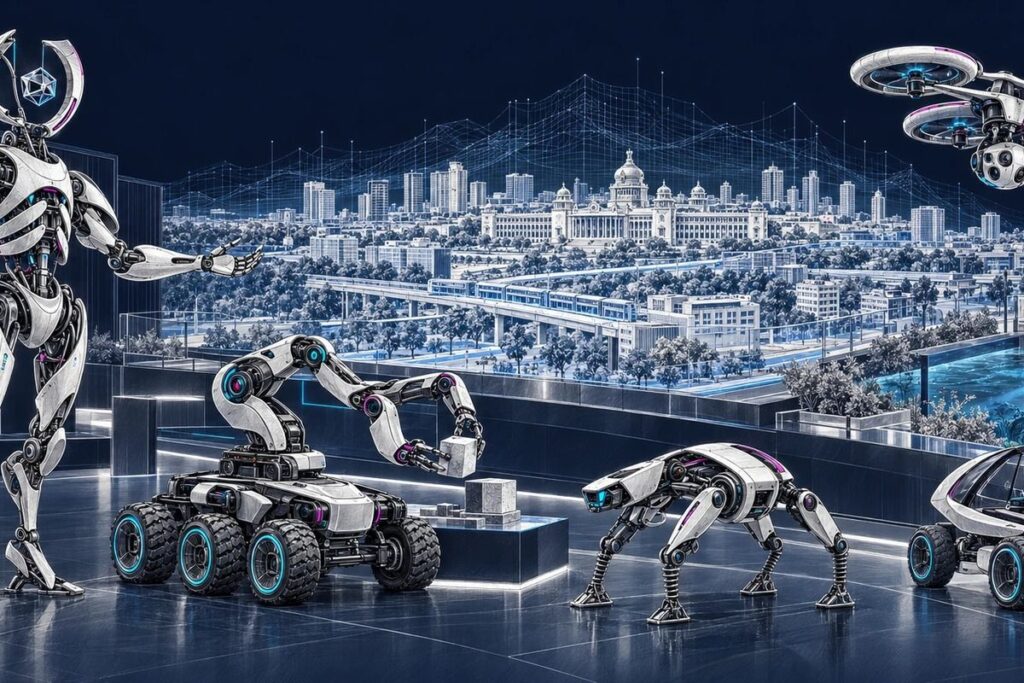
The humanoid robots, quadrupeds, and drones displayed at Bengaluru Tech Summit 2026 are engineered and programmed in India, but industry supply-chain disclosures and government trade records show that roughly 70% of the electronic and precision motion hardware inside Indian robotics is imported. While Bengaluru startups build outer frames, wiring, and control software locally, core actuators, laser sensors, and onboard processors come from China, Taiwan, and the United States.
Which Parts of Bengaluru Tech Summit 2026 Robotics Are Built Locally vs. Imported?
Inside the 101 displays across the 50,000-square-foot AI and Robotics Pavilion at the Bengaluru International Exhibition Centre, Indian engineers design mechanical structures, write locomotion code, and assemble final units, while high-precision motion and sensing parts are sourced abroad.
Bengaluru-based General Autonomy, which demonstrated its 1.43-metre humanoid Taara alongside its four-legged robot PARAM at the summit, shows how domestic firms divide their builds. According to technical specifications compiled by RobotToday and reporting by, PARAM is designed and fabricated in India, including its carbon-fiber chassis, aluminum frame, wiring, and battery management systems, while running on imported NVIDIA compute modules and specialized joint actuators.
A subsystem audit of the machines displayed on the pavilion floor separates domestic manufacturing from overseas sourcing:
- Frames and power boards (India): Sheet-metal and carbon-fiber chassis, custom wiring harnesses, battery management systems, and printed circuit boards (PCBs) that regulate electrical power.
- Joints and motors (China and Taiwan): Brushless direct-current (BLDC) torque motors, compact electric motors built to deliver high twisting force at low speeds, and strain-wave gearboxes, which are precision metal gear assemblies that move robotic joints without mechanical slack.
- Spatial sensors (China and the United States): Solid-state LiDAR units, laser-based distance sensors that map rooms in three dimensions, and industrial inertial measurement units (IMUs) that measure tilt and acceleration to keep walking robots balanced.
- Onboard AI computers (United States and Taiwan): Edge AI modules, specifically NVIDIA Jetson and Orin processors fabricated in Taiwan for the California chipmaker, that process camera and sensor feeds directly on the robot without cloud servers.
What Does Indian Trade Data Show About the Robotics Supply Chain?
Government trade records confirm that India’s growing robotics assembly sector depends heavily on imported hardware, with annual automation imports exceeding ₹42,000 crore and domestic factories supplying only 30% of required electronic components.
According to a joint white paper by the Indian Institute of Science’s ARTPARK and the Ministry of Heavy Industries, India’s annual imports of industrial robots, actuators, controllers, and automation hardware surpassed ₹42,000 crore in FY2022–23. Separate data published by the Office of the Development Commissioner (Micro, Small and Medium Enterprises) establishes that domestic manufacturers produce 30% of the electronic components used in India, leaving 70% dependent on imports.
Customs tariff headings, including Harmonized System (HS) code 8501 for electric motors and HS code 8483 for transmission gears and ball screws, lump robotics parts together with ceiling fans, factory machinery, and automotive transmissions. Even so, supply-chain analysis of India’s robotics sector documents that India’s largest warehouse automation firms still import advanced actuators and optical sensors because local precision machine shops cannot yet match East Asian tolerances at commercial scale.
How Much of India’s “Physical AI” Relies on Foreign Models and Silicon?
Every robot showcased under the “Physical AI” banner, a term describing artificial intelligence software embedded in physical machines that perceive and act in the real world, runs its locally written movement code on foreign edge processors and simulation stacks.
Startups at the summit demonstrated machines capable of interpreting voice prompts, sorting warehouse parcels, and climbing uneven stairs. Underneath custom Indian control policies, engineering teams train walking algorithms on imported graphics processing unit (GPU) clusters before deploying them onto US-designed NVIDIA edge chips subject to federal export rules. As noted in the Ministry of Electronics and Information Technology’s (MeitY) Draft National Strategy on Robotics, India holds strong software engineering capacity but lacks domestic semiconductor fabrication, leaving robot controllers and vision boards reliant on imported silicon.
The line between local software integration and foreign hardware drew national scrutiny earlier in 2026, when Galgotias University faced official backlash at the India AI Impact Summit in New Delhi after presenting a commercially purchased Chinese Unitree Go2 quadruped as an in-house invention. Bengaluru’s exhibiting startups design their own mechanical chassis and control software, yet still rely on imported sub-assemblies to make those machines move.
Why Do Indian Manufacturing Subsidies Miss Robotics Sub-Assemblies?
Federal production subsidies bypass robotics component makers because existing incentive schemes require high-volume consumer electronics output and capital outlays starting at ₹50 crore, well above what low-volume robotics suppliers generate.
At BTS 2026, Karnataka Chief Minister D.K. Shivakumar announced ₹1,050 crore in deeptech investment commitments alongside the nine-acre Bengaluru Robotics and AI Innovation Zone (BRAINZ). While state grants fund prototype R&D and engineering payrolls, national factory incentives target mass-produced hardware.
A review of MeitY’s Production Linked Incentive (PLI) Scheme 2.0 for IT Hardware and the Electronics Component Manufacturing Scheme (ECMS) notified in April 2025 shows that turnover-linked payouts cover laptops, servers, display panels, and multi-layer PCBs, requiring cumulative investments between ₹50 crore and ₹1,000 crore. A robotics firm ordering 200 custom joint actuators cannot hit the factory volumes needed to qualify.
At the state level, Karnataka’s Electronics System Design and Manufacturing (ESDM) policy offers 20% capital subsidies on plant machinery and power tariff concessions. Without targeted tooling support for rare-earth permanent magnets, strain-wave gear grinding, and LiDAR optics, Bengaluru startups continue buying off-the-shelf actuators from East Asian catalogs at a fraction of domestic custom-machining prices.
Where Does Real Indian Robotics IP Live, And What Will Localization Require?
Indian robotics founders and researchers argue that value creation lies in control firmware, tactile perception, and fleet orchestration software rather than commodity motor winding, noting that US and European humanoid developers also source actuators from East Asia and edge chips from NVIDIA.
At a February 2026 national robotics consultation hosted by the Office of the Principal Scientific Adviser, General Autonomy co-founder Farid Ahsan and GreyOrange Chief Executive Officer Akash Gupta stated that competitive advantage rests on embodied AI software tailored to unstructured Indian industrial terrain, while urging policymakers to create accredited hardware testing labs and robotics-specific PLI tiers.
Targeted component localization projects are already active in Bengaluru:
- Supplier prototyping: Through the Center for Advanced Manufacturing for Robotics and Autonomous Systems (CAMRAS) at IISc’s ARTPARK, researchers and more than 465 Indian vendors are developing domestic soft actuators, inertial sensors, and motor controllers.
- Precision motors: In September 2026, Bengaluru-based Hical Technologies qualified India’s first homegrown coreless BLDC motor for satellite orientation systems, proving local manufacturers can meet tight electromagnetic tolerances when backed by qualification contracts.
Whether BRAINZ’s planned nine-acre campus at IISc lowers the 70% import share over the next 24 months depends on how its targeted ₹1,000-crore five-year budget is allocated: funding shared gear-grinding foundries and sensor calibration labs can build a local supply base, while funding software incubation alone will keep Bengaluru’s robots dependent on overseas hardware shipments.
For background on how imported robotic hardware sparked wider policy scrutiny across India’s 2026 technology summits, watch Firstpost’s report on the AI Summit robotics controversy.
Frequently Asked Questions
Are the humanoid robots and robot dogs at Bengaluru Tech Summit 2026 made in India?
Indian startups such as Bengaluru-based General Autonomy design the mechanical frames, wiring harnesses, battery systems, and locomotion software in India, but roughly 70% of the underlying precision electronic and motion hardware, including torque motors, strain-wave gearboxes, LiDAR sensors, and NVIDIA edge AI processors, is imported from China, Taiwan, and the United States.
How much robotics and automation hardware does India import each year?
According to a joint white paper by the Indian Institute of Science’s ARTPARK and the Ministry of Heavy Industries, India’s annual imports of industrial robots, actuators, controllers, and automation equipment exceeded ₹42,000 crore in FY2022–23, while data from the Office of the Development Commissioner (MSME) shows domestic factories produce only 30% of required electronic components.
Why don’t Indian robotics startups source motors and sensors from local factories?
Existing federal incentives such as MeitY’s PLI Scheme 2.0 for IT Hardware and the April 2025 Electronics Component Manufacturing Scheme target mass-market electronics requiring ₹50 crore to ₹1,000 crore in capital investment, leaving low-volume robotics startups without local suppliers capable of matching East Asian precision tolerances and catalog pricing on strain-wave gears and LiDAR units.
What is Karnataka’s BRAINZ initiative announced at Bengaluru Tech Summit 2026?
Unveiled by Chief Minister D.K. Shivakumar at BTS 2026, the Bengaluru Robotics and AI Innovation Zone (BRAINZ) is a planned nine-acre robotics and physical AI hub developed with IISc’s ARTPARK that targets ₹1,000 crore in investment over five years to build shared testing infrastructure and hardware prototyping facilities.