






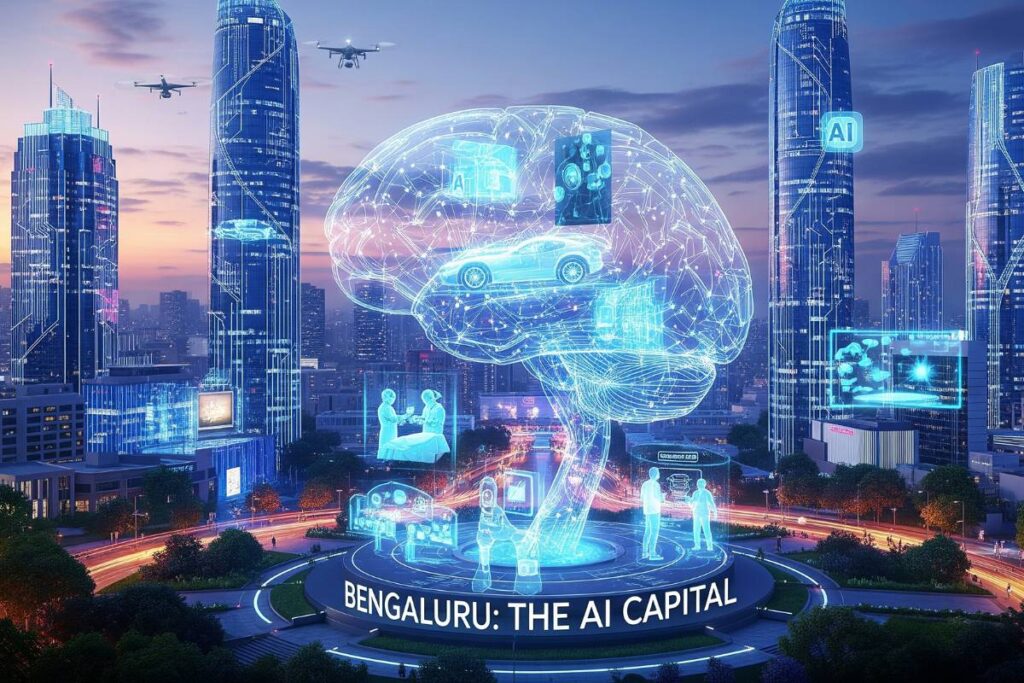
Bengaluru secured the 26th spot on the 2025 Global AI City Index, cementing its status as India’s top technology hub. The Counterpoint Research data points to a broader shift in global tech dominance, as Asian cities aggressively outpace Western hubs. Singapore captured the number one spot worldwide.
Decoding the 2025 Global AI City Index
The 2025 Global AI City Index evaluates the top 100 urban tech ecosystems. The index measures sustainable, cross-sector AI integration rather than simple tech demos. The methodology analyzes:
- Over 5,000 public and private sector AI initiatives.
- Communications infrastructure, including 5G rollout, fiber networks, and supercomputing capacity.
- Academic research output and institutional influence.
- Startup ecosystem vitality, prioritizing capital attraction and growth velocity.
- Practical application across critical industries such as healthcare, logistics, and telecommunications.
Singapore: The Blueprint for AI Dominance
Singapore’s ascent to the top of the global rankings stems from methodical policy execution. The city-state cultivated a highly regulated yet innovative environment driven by public-private partnerships.
- Strategic Government Investment: State-backed initiatives like AI Singapore channel capital and talent directly into high-growth sectors.
- Startup Density: A dense concentration of AI startups fueled by collaborations between leading universities and multinational enterprises.
- Real-World Deployment: Widespread integration of AI in healthcare diagnostics, intelligent transport systems, and telecom infrastructure.
- Workforce Readiness: Aggressive integration of digital and AI literacy into the national education curriculum, targeting primary and secondary schools by 2025.
Bengaluru: India’s Engine in the AI Race
Bengaluru’s 26th-place finish underscores India’s expanding footprint in the global tech hierarchy. While trailing top-tier global leaders, the city outpaces domestic rivals like Mumbai, Delhi, Chennai, and Kolkata by a wide margin. The data points to a maturing ecosystem transitioning from outsourced IT services to core innovation:
- Venture Capital Magnet: In 2024, Bengaluru secured 140 venture capital deals totaling $3.3 billion, with 34 transactions exclusively targeting AI ventures.
- Unicorn Density: The city houses 28 tech unicorns, many heavily invested in machine learning and data science.
- Infrastructure Expansion: Multinational technology firms are expanding their AI research and development centers and data infrastructure within the city limits.
- Sector Diversification: Global Capability Centers (GCCs) in Bengaluru are leveraging AI for complex problem-solving in healthcare, insurance, and supply chain logistics.
The Fast-Track Cities Emergence
The 2025 index highlights several accelerating hubs disrupting the established tech hierarchy. Cities identified as the fastest-growing AI hubs include:
- Riyadh
- Hangzhou
- São Paulo
- Bengaluru
These emerging hubs attract deep capital pools and develop aggressive talent pipelines, proving that the next wave of AI innovation will be highly decentralized.
Bridging the Gaps in India’s Ecosystem
Despite Bengaluru’s impressive trajectory, the Counterpoint report highlights structural deficiencies that Indian policymakers must address to break into the global top tier.
- Infrastructure Deficits: A pressing need for expanded supercomputing capabilities, advanced research laboratories, and denser 5G and fiber networks.
- Educational Bottlenecks: While cities like Beijing and Singapore mandate formal AI literacy, Indian urban centers lag in standardized, early-stage technical education.
- Regulatory Ambiguity: The absence of a unified, comprehensive AI regulatory framework addressing ethics, data privacy, and intellectual property.
- The Digital Divide: Persistent infrastructural gaps between urban tech corridors and broader regional areas slow national AI integration.
The Global Top 5: Asia’s Growing Footprint
A closer look at the highest-ranking cities reveals a decisive shift toward Asian dominance, with six regional metropolises breaking into the top ten.
| Rank | City | Country | Key Drivers |
| 1 | Singapore | Singapore | Public-private synergy, advanced 5G, systemic AI literacy, startup density. |
| 2 | Seoul | South Korea | AI-integrated healthcare, aggressive government funding, premier research universities. |
| 3 | Beijing | China | Massive state capital, top-down tech education, hub for domestic tech giants. |
| 4 | Dubai | UAE | Smart city infrastructure, flexible regulatory environment, aggressive foreign tech investment. |
| 5 | San Francisco | United States | Historic venture capital dominance, premier talent concentration, foundational AI research. |
The 2025 Global AI City Index validates India’s potential to transition from a service-oriented tech sector to a global AI architect. However, challenging leaders like Singapore and Seoul requires aggressive infrastructure development, sweeping educational reforms, and decisive regulatory frameworks.
Related: India Soars, Becoming the World’s 5th Largest Aviation Market
Sources: DD News