







How Anthropic Operationalizes AI Safety With Claude
In the high-stakes race toward artificial general intelligence (AGI), governance frameworks dictate the boundary between safe deployment and catastrophic risk. Anthropic, the frontier research lab behind Claude, defines this boundary through its Responsible Scaling Policy (RSP). As detailed in our analysis of Claude 3.7 Sonnet and autonomous agent architectures, scaling computational capacity without commensurate containment protocols risks crossing critical safety thresholds. This reality necessitates strict AI Safety Level (ASL) standards.
Beyond Human Feedback: Constitutional AI
Traditional alignment models relied heavily on Reinforcement Learning from Human Feedback (RLHF), a methodology that breaks down as models exceed human evaluative capacity. Anthropic pioneered Constitutional AI (RL from AI Feedback), replacing human raters with a system where the model critiques and refines its own outputs against codified principles—many derived from the UN Declaration of Human Rights. In recent frontier reasoning evaluations, this self-correcting alignment layer successfully prevented adversarial jailbreaks while maintaining top-tier problem-solving capabilities.
The Safeguards Infrastructure and Usage Policy
Anthropic enforces its safety guidelines through a dedicated Safeguards Team, comprising policy experts, data scientists, and threat analysts tasked with offensive modeling to anticipate novel misuse vectors. This multidisciplinary approach is designed to eliminate blind spots inherent in purely engineering-driven safety teams.
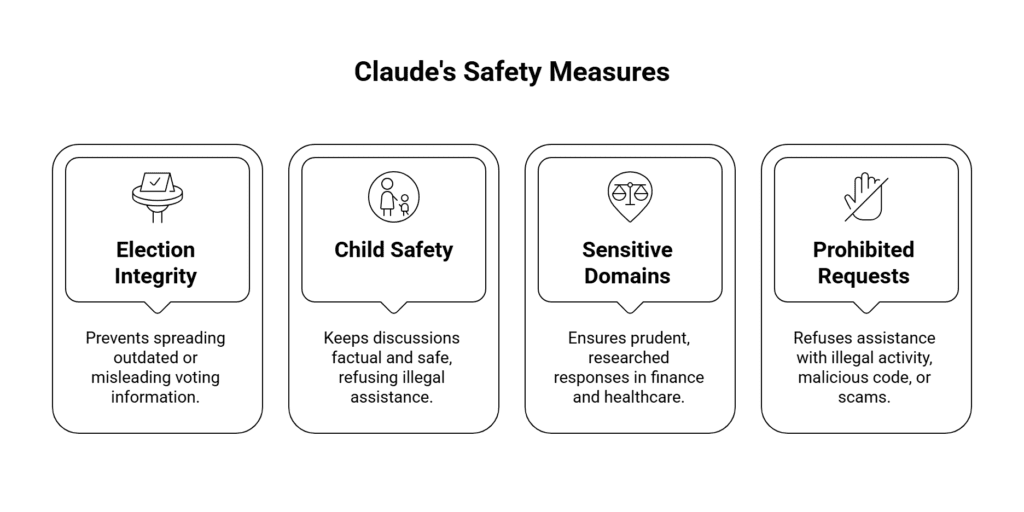
The Unified Harm Framework
Static acceptable-use policies routinely fail to anticipate novel biological or cyber risks. Anthropic’s Unified Harm Framework relies on rigorous threat modeling for chemical, biological, radiological, and nuclear (CBRN) hazards. As examined in our technical investigation into DNA printer biosecurity screening, frontier models capable of synthesizing novel viral vectors or automating offensive cyber operations automatically trigger ASL-3 containment requirements. Under these strict rules, model weights must be isolated within air-gapped cryptographic enclaves.
Every new policy or feature is continuously evaluated across physical, psychological, economic, and societal harm vectors. The framework forces developers to identify worst-case scenarios and engineer corresponding mitigation strategies prior to deployment.
Adversarial Red-Teaming and Vulnerability Testing
Internal testing is insufficient for frontier models. Anthropic routinely subjects Claude to Policy Vulnerability Tests conducted by external experts in counter-terrorism, child safety, and offensive cybersecurity. These policy white hat hackers probe the model for edge-case vulnerabilities, identifying gaps in the alignment training that engineers subsequently patch.
Pre-Deployment Evaluations and Real-Time Monitoring
Before any major model release, Anthropic executes three distinct evaluation tracks:
- Safety Evaluations: Testing the model’s adherence to usage policies under extreme or complex prompting.
- Risk Assessments: High-stakes evaluations focusing on cyber and bio-risks, often conducted in coordination with industry and government partners.
- Bias Evaluations: Auditing model outputs across demographic and political lines to ensure equitable performance.
Post-deployment, Claude is continuously monitored via automated classifiers—specialized AI models trained to detect policy violations in real-time. These classifiers can autonomously block dangerous outputs, warn users, or flag accounts for human review by the Safeguards Team. Additionally, privacy-preserving analytics track aggregate usage patterns to detect coordinated misuse, such as botnets probing for structural vulnerabilities.
Government Integration and Independent Auditing
Independent verification remains the cornerstone of Anthropic’s deployment strategy. The company established pre-deployment evaluation agreements with both the US AI Safety Institute (NIST AISI) and the UK AI Safety Institute, granting government scientists early API access for independent red-teaming. These proactive measures align with broader industry efforts to establish CFAA safe harbor rules for AI security researchers.
Threat Vector Modeling & Zero-Trust Defense Architecture
In enterprise technology environments, securing advanced digital assets requires implementing comprehensive Zero-Trust Architecture (ZTA) aligned with NIST SP 800-207 standards. Modern attack vectors increasingly exploit identity federation vulnerabilities, session token manipulation, and sophisticated pretexting campaigns that circumvent traditional perimeter defenses. Establishing continuous micro-segmentation, cryptographically attested device identity, and hardware-backed FIDO2/WebAuthn multifactor authentication eliminates single-point authentication compromises.
Regulatory Compliance & Governance Standards (NIST AI RMF & ISO/IEC 42001)
As regulatory scrutiny intensifies globally—exemplified by the enforcement of the European Union AI Act and mandatory SEC cyber incident disclosure mandates (Item 1.05 of Form 8-K)—organizations must establish verifiable audit trails for algorithmic safety, model provenance, and data retention. Implementing standardized risk assessments following the NIST AI Risk Management Framework (AI RMF 1.0) and ISO/IEC 42001 certifications guarantees that automated decision systems maintain strict containment boundaries, prompt-injection defense mechanisms, and differential privacy guarantees.
Enterprise Incident Response & Continuous Automated Red-Teaming
Effective technical resilience requires transitioning from reactive patch management to continuous automated adversarial red-teaming. Deploying automated fuzzing suites, canary token deployments, and continuous telemetry monitoring across API endpoints allows security teams to identify subtle model drifts, unauthorized data exfiltration channels, and shadow infrastructure before malicious adversaries can weaponize system vulnerabilities.