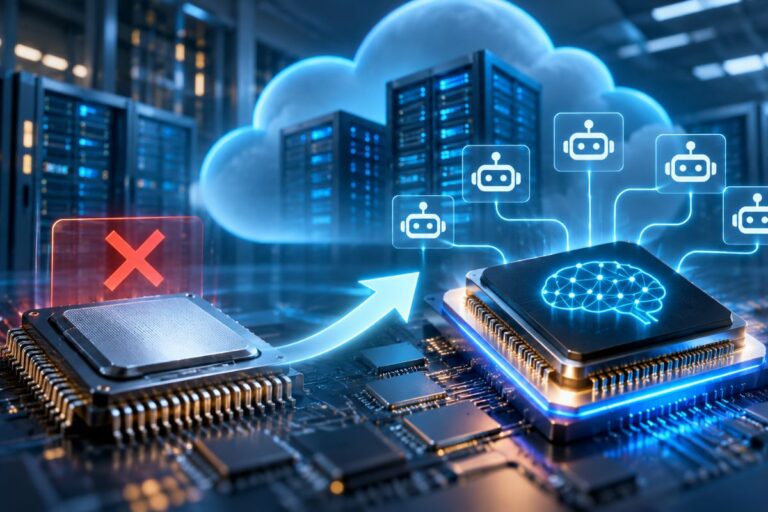







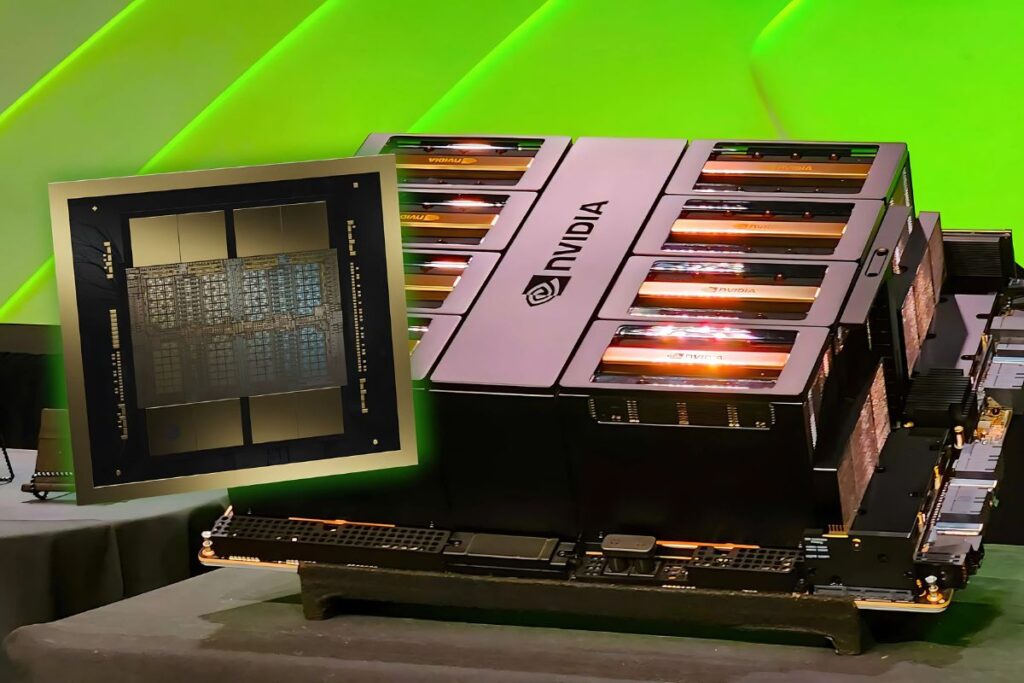
NVIDIA’s Blackwell architecture has officially entered the enterprise data center, pushing a fundamental shift from cloud-dependent AI to high-density, on-premises infrastructure. Expanding on the B200 and GB200 NVL72 superchips detailed in NVIDIA’s official documentation, the new server lineup targets localized large language model (LLM) inference, real-time physics simulation, and industrial robotics.
Hardware Specifications and Efficiency Metrics
Major OEMs—including Cisco, Dell Technologies, HPE, Lenovo, and Supermicro—are now backing the Blackwell-powered servers. Built to manage severe space, power, and thermal constraints, the hardware introduces a denser footprint for localized computing.
- 2U configurations designed for maximum spatial efficiency.
- Up to eight GPUs per server.
- 45× faster performance than legacy CPU-only enterprise systems.
- 18× higher energy efficiency, easing the thermal load for on-premises “AI factories.”
Dell Technologies has integrated Blackwell accelerators into its PowerEdge XE and R7725 platforms, pairing them with NVIDIA AI Enterprise software, ConnectX-7 NICs, and BlueField-3 DPUs to guarantee deterministic throughput for clustered workloads.
Core Architecture Innovations
The Blackwell silicon introduces several key hardware upgrades directly tied to benchmark improvements:
- Fifth-generation Tensor Cores.
- Second-generation Transformer Engine utilizing ultra-fast FP4 (4-bit floating point) precision.
- Fourth-generation RTX technology, capable of 4× the rendering speed of older L40S models.
- Multi-Instance GPU (MIG) support, isolating workloads by partitioning single GPUs into four separate environments.
In MLCommons MLPerf Inference benchmarks, the FP4 micro-tensor arithmetic achieves up to 30× faster inference and 25× lower energy consumption versus H100 Hopper nodes. This strict hardware-software optimization reinforces NVIDIA’s deep integration, avoiding the interconnect bottlenecks that have plagued competitors—as seen in our analysis of NVIDIA CUDA vs Huawei CANN software moats and DeepSeek’s hardware training setbacks.
Physical AI, Robotics, and Digital Twins
Beyond natural language processing, Blackwell targets physical AI environments. Utilizing massive 8-Hi and 12-Hi HBM3E memory pools—avoiding the fabrication hurdles detailed in our CXMT HBM3E mass production yields report—enterprises can drive high-fidelity simulations via the NVIDIA Omniverse and Isaac Robotics platforms.
- Digital twin simulations for automotive engineering, urban planning, and factory layouts.
- Robotic training routines powered by large-scale synthetic datasets.
- Accelerated industrial inspection for manufacturing, surveillance, and surgical robotics.
This localized processing capability ensures companies can execute intensive physics models without breaching strict on-premises power budgets or relying on costly hyperscaler energy overheads.
Expanded Software Toolkits
NVIDIA is continuously updating its software stack to complement the hardware release:
- Omniverse SDKs: Now supporting MuJoCo (MJCF) and Universal Scene Description (OpenUSD).
- Cosmos World Foundation Models: Facilitates mass generation of synthetic robotics training data from text, image, or video prompts.
- NuRec Libraries: Features real-time, ray-traced 3D Gaussian splatting to synthesize realistic sensor data.
Industry leaders, including Boston Dynamics, Amazon Devices, Ford, and Porsche, are currently deploying these frameworks to optimize intelligent manufacturing and autonomous vehicle logistics.
Vision-Language AI and Llama Nemotron Super
NVIDIA’s Cosmos Transfer-2 model expedites image data creation, enabling rapid, customized dataset generation for firms like Lightwheel and Moon Surgical. Cosmos Reason, a 7-billion-parameter vision-language model, merges text, visual, and physics data so AI agents can parse multistep tasks and analyze long-form video feeds.
For LLM workloads, Blackwell RTX PRO Servers running the Llama Nemotron Super model with NVFP4 precision deliver up to 3× better price-performance compared to FP8 on prior H100 GPUs. This cost-efficiency sets a new baseline for enterprise deployments, proving on-premises infrastructure can sustainably support heavy AI demands while remaining highly efficient.

Silicon Architecture & Microbenchmarks: Systems Engineering Implications
From a hardware systems architecture perspective, evaluating modern compute platforms requires examining interconnect bandwidth, thermal dissipation limits, and memory subsystem topology rather than peak theoretical FLOPS alone. In distributed training clusters, compute throughput is routinely throttled not by raw arithmetic logic unit (ALU) density, but by memory wall bottlenecks and bisection bandwidth across the network fabric. High-bandwidth memory (HBM3e) integration, 2.5D/3D chiplet packaging (such as TSMC’s CoWoS), and optical interconnects represent the primary physical determinants of real-world model convergence times.
Data Center Power Delivery, Liquid Cooling, and TCO Metrics
Deploying advanced accelerator architectures imposes severe constraints on modern hyper-scale data center infrastructure. Rack densities exceeding 100 kW to 120 kW mandate a decisive transition away from conventional forced-air cooling toward direct-to-chip liquid cooling or two-phase immersion systems. Facility engineers must balance power usage effectiveness (PUE), fluid loop flow rates, and parasitic pumping power against the operational risks of dielectric fluid degradation. Furthermore, hardware reliability metrics—specifically Mean Time Between Failures (MTBF) of high-speed SerDes links and optical transceivers—dictate checkpointing cadences and cluster-wide compute efficiency.
Enterprise Deployment Architecture & Long-Term Roadmap
For enterprise IT architects and infrastructure operators, mitigating vendor lock-in requires decoupling software pipelines from proprietary hardware primitives. Implementing open accelerator frameworks, hardware-agnostic kernel compilers (such as OpenAI Triton, Modular Mojo, and MLIR abstractions), and standardized workload orchestrators (Kubernetes with custom device plugins) ensures enterprise software stacks can dynamically schedule compute across heterogeneous silicon fabrics without costly architectural refactoring.